


01
Introduction
With the rise of generative AI, consumers increasingly receive summarized, conversational answers instead of scrolling through ten blue links.
Discovery, validation, and even checkout are beginning to merge into one seamless interaction, sometimes without a single click to a brand’s website.
This shift is real. But it is also nuanced.
Today, SEO still drives the majority of measurable digital visibility and website traffic. In most organizations, organic search remains one of the largest traffic contributors. Based on our internal observations, SEO accounts for roughly 40% of website traffic, while GEO-driven traffic currently represents less than 1%.
However, traffic alone no longer tells the full story.
Even when AI-generated answers do not drive immediate clicks, they increasingly shape brand selection, shortlisting, and purchase intent upstream. Visibility is expanding beyond ranking. It is moving towards being referenced, summarized, and trusted within AI-generated answers.
This is where GEO (Generative Engine Optimization) becomes critical.
What is GEO?
Generative Engine Optimization (GEO) is the evolution of SEO in an AI-first discovery environment.
If SEO is about ranking web pages,
GEO is about being selected inside answers.
But it is essential to be clear:
GEO does not replace SEO. It builds on it.
SEO remains the foundation. Your content must still be crawlable, indexable, technically structured, and authoritative to be eligible for any kind of visibility, including AI-led selection.
GEO extends those same foundations into generative environments.
Search is shifting from lists of links to synthesized responses, and brands are not competing only for the top position on a results page. They are competing for inclusion within AI-generated summaries.
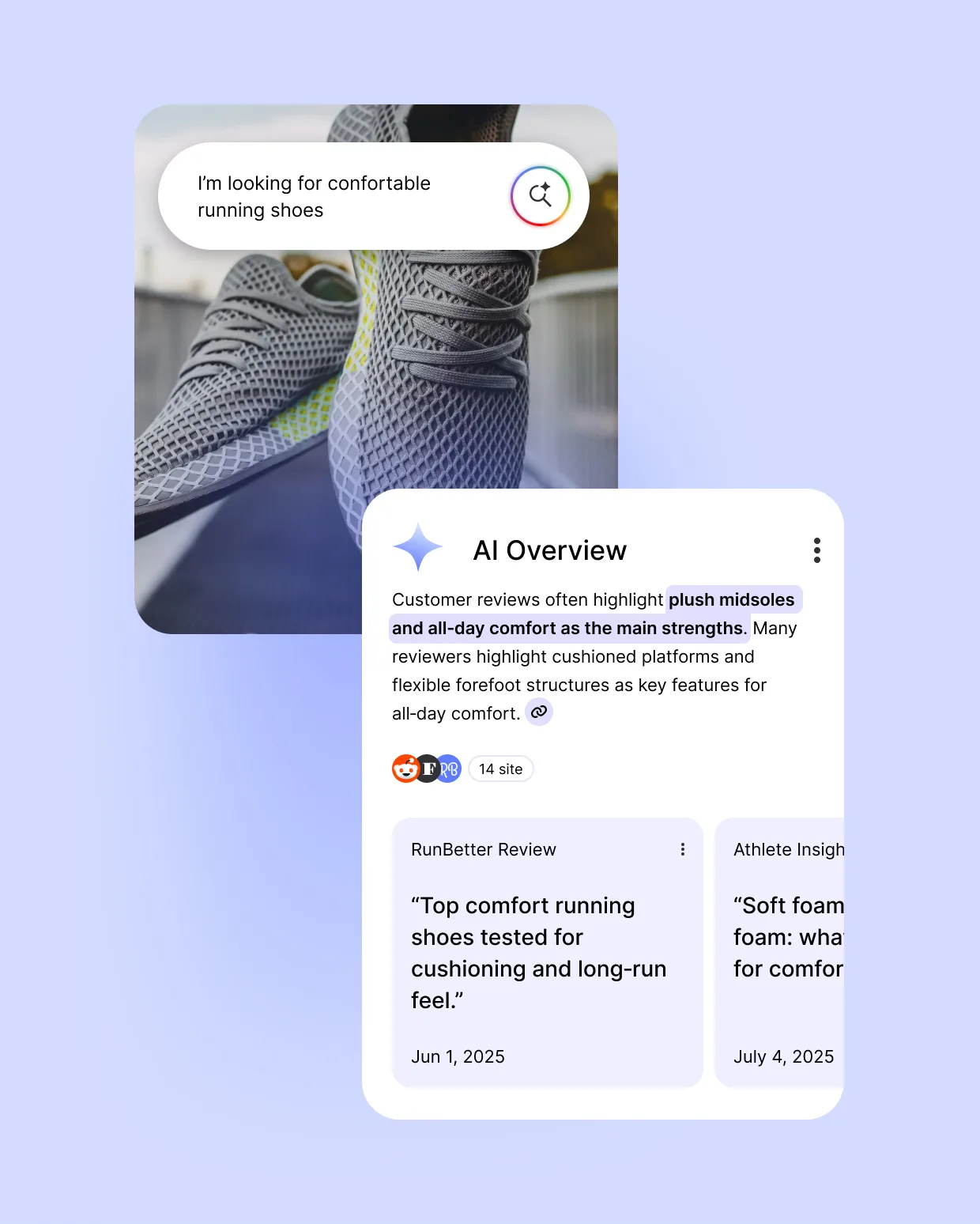
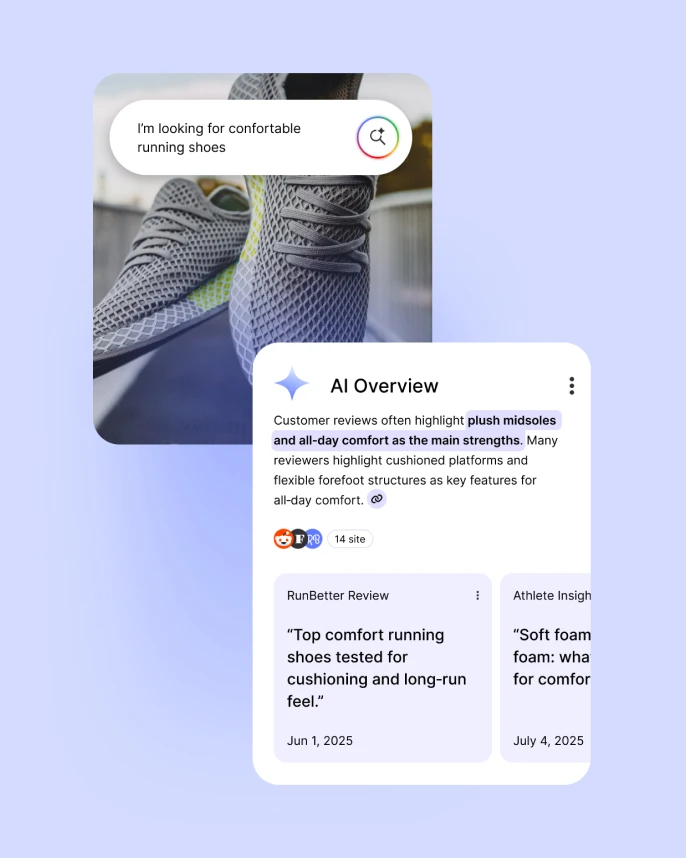
GEO can be defined as:
Optimizing your content to be selected, summarized, and cited in AI-generated answers.
This applies to conversational interfaces, AI overviews, shopping assistants, and generative discovery tools that interpret intent and aggregate multiple sources before presenting a response.
Unlike traditional SEO, which measures performance primarily through rankings and traffic, GEO expands the visibility model to include:
- Citation in AI-generated summaries
- Inclusion in product comparisons
- Presence in AI-generated pros and cons
- Representation in conversational commerce flows
Importantly, GEO often influences decisions before a click happens.
Today, its direct traffic impact may be limited. But its influence on perception, shortlisting, and trust formation is growing.
In short, SEO makes you discoverable.
GEO increases the likelihood that you are chosen.


02
The New Discovery Funnel Is Collapsing
For years, digital commerce followed a predictable funnel:
awareness, consideration, comparison, and finally conversion. Each stage required multiple touchpoints, clicks, and website visits.
That linear model is breaking down.
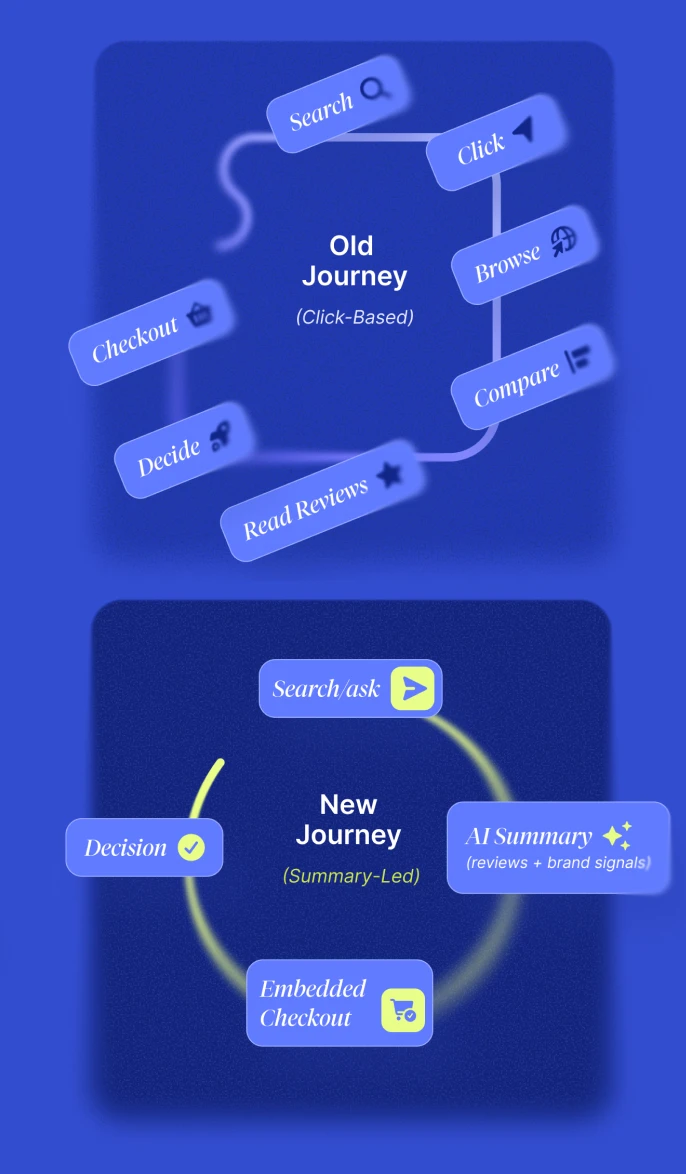
Today, discovery, validation, and purchase intent increasingly happen within the same interface. Instead of navigating across tabs, platforms, and product pages, consumers receive synthesized answers that compress the journey into a single decision moment.
The funnel is no longer expanding outward.
It is collapsing inward.
AI suggests products.
Instead of browsing category pages, consumers ask contextual questions. AI interprets intent and recommends products based on aggregated sources, reviews, and structured data.
Reviews are summarized instantly.
Rather than reading dozens of comments, users see condensed pros, cons, and sentiment analysis pulled directly from customer reviews and UGC. Validation happens in seconds.
Checkout is embedded.
Social platforms, marketplaces, and AI interfaces increasingly enable in-app or in-interface transactions. The distance between recommendation and purchase is shrinking.
Discovery, Consideration,
and Checkout Are Merging
Generative AI is accelerating the convergence of what were once distinct stages of the customer journey.
The Journey Is Collapsing

What a Zero-Click Shopping
Experience Looks Like
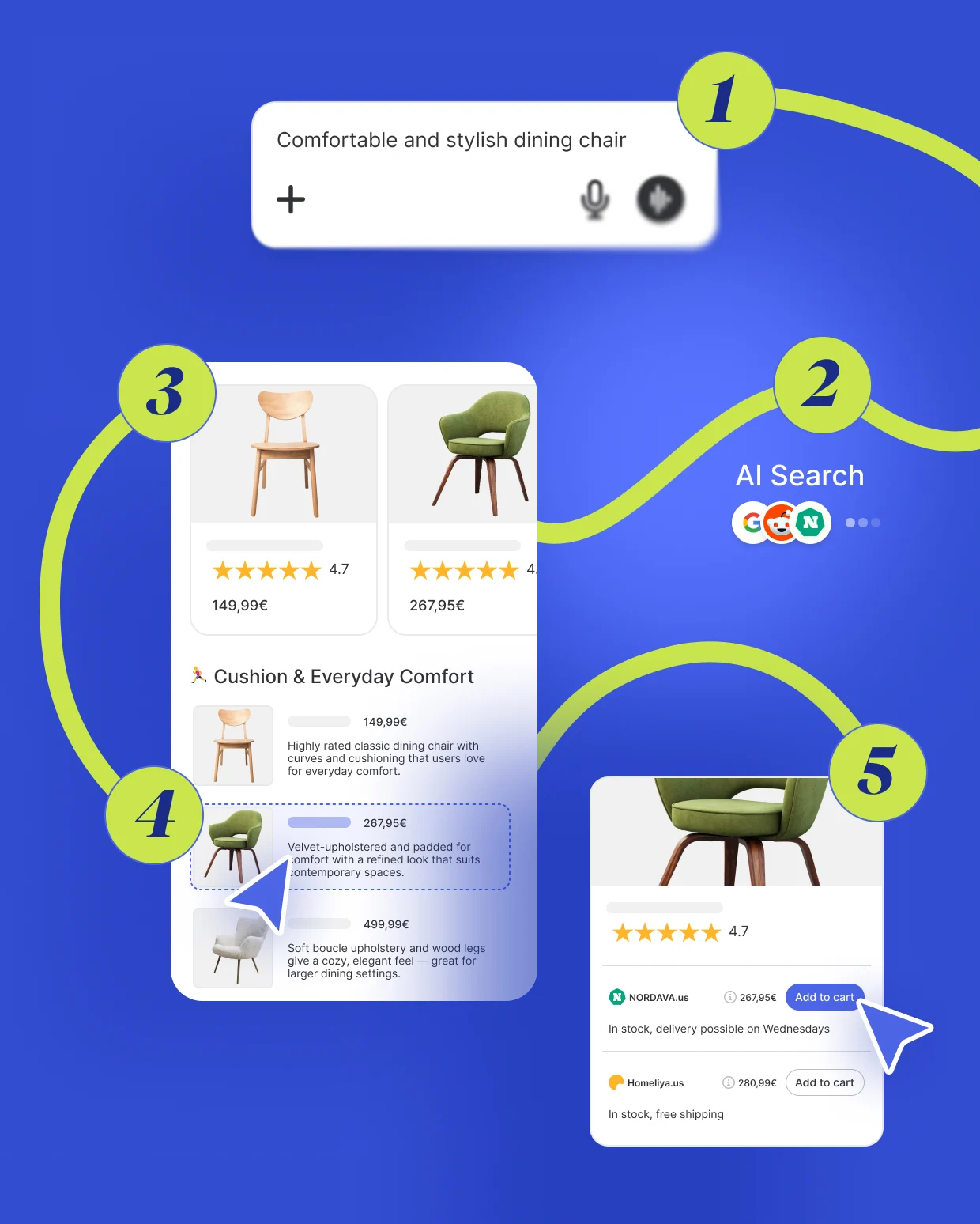
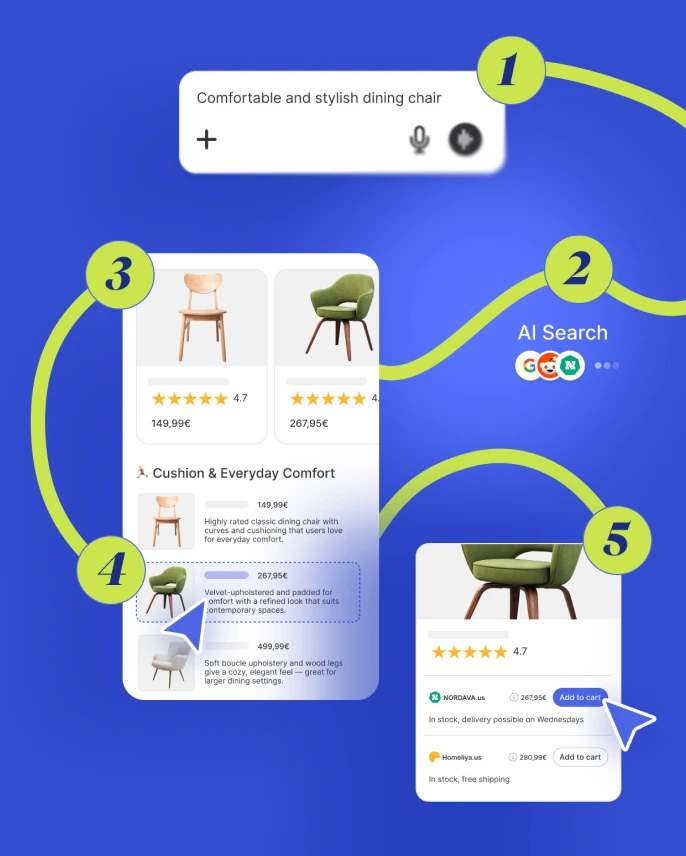
A zero-click shopping experience removes friction by keeping the entire journey inside one conversational or AI-driven interface.
Here’s an example of a typical journey:
1. A consumer asks ChatGPT or an AI-powered search engine:
“What’s the best lightweight running shoe for flat feet under €150?”
2.The AI engine synthesizes product comparisons using reviews, ratings, structured data, and expert signals.
3.It presents:
An AI cited recommendation
A short summary of pros and cons
Average rating and review volume
Contextual use-case insights
The consumer selects the recommended product.
4.Purchase happens directly via:
Embedded checkout
Marketplace integration
In-app social commerce
No traditional browsing. No comparison across five websites. No extended research journey.
The decision happens where the answer is delivered.
Market Signals You Can’t Ignore
Zero-click search is growing.
80% of consumers now depend on zero-click results for at least 40% of their searches, contributing to an estimated 15–25% decline in organic traffic.

AI is increasingly used in product discovery.
A rising percentage of consumers report using AI tools to research or compare products before purchase. AI predicts what customers need with 85%+ accuracy.

Reviews remain decisive.
Over 75% of shoppers still consider reviews and real customer content essential before making a purchase decision.
(Skeepers Consumer Report)

Social proof drives trust.
70% of consumers trust user-generated content more than traditional brand messaging.
(Skeepers Consumer Report)


03
How Reviews and UGC Power
Zero-Click Shopping
If GEO determines whether your brand is selected inside AI answers,
reviews and UGC determine whether your brand is trusted enough to be selected.
Generative AI does not invent product experience. It aggregates and summarizes it. And the richest, most scalable source of real product experience online is user-generated content.
Reviews, ratings, photos, videos, and consumer conversations form the raw material AI systems analyze when generating product comparisons, pros and cons, recommendations, and brand credibility signals.


AI systems are designed to synthesize experience at scale.
They analyze language patterns, sentiment, structured data, and recurring themes to generate contextual answers. Reviews and UGC are uniquely suited for this because they provide:
In short, reviews reflect lived experience.
And AI systems prioritize lived experience over brand claims.
The Discovery to Decision Loop
To understand how reviews power zero-click discovery, it helps to visualize the loop.
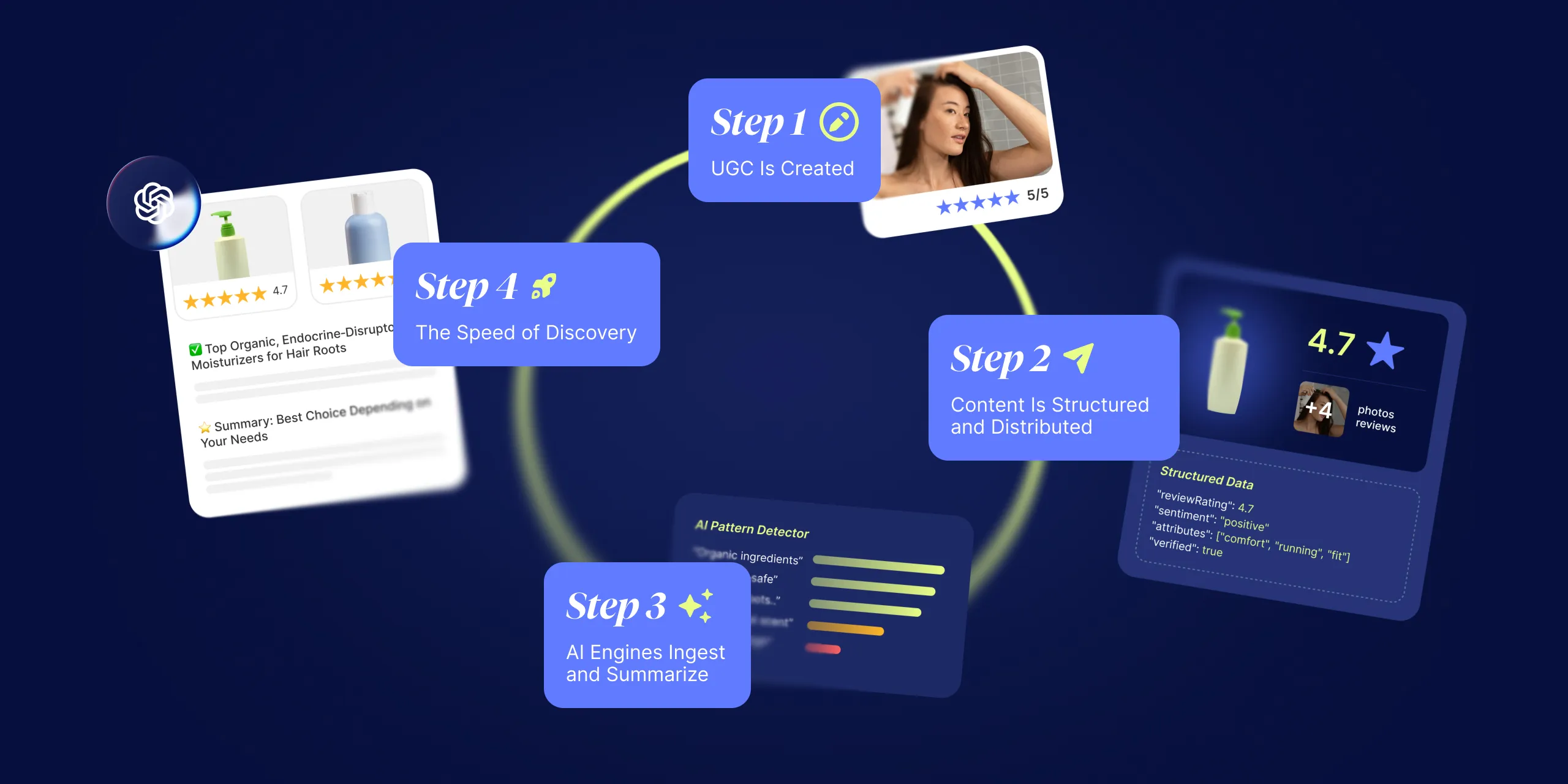
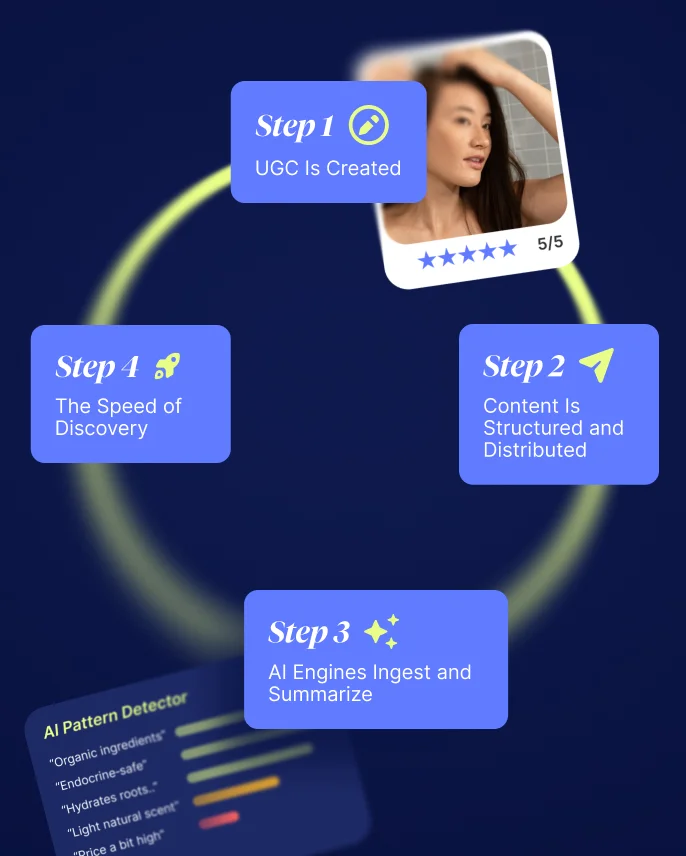
Step 1 — UGC Is Created
Consumers generate:
Star ratings
Written reviews
Photos and videos
Store-level feedback
Social content
This content captures authentic experience signals.
Step 2 — Content Is Structured and Distributed
Through:
Schema markup
Review widgets
Product feed enrichment
Syndication across search, shopping, and local platforms
At this stage, content becomes machine-readable and AI-ingestible.
Step 3 — AI Engines Ingest and Summarize
Generative systems:
Detect recurring product attributes
Analyze sentiment trends
Extract pros and cons
Rank perceived strengths
This becomes the synthesized answer shown to consumers.
Step 4 — Shoppers Validate Instantly
Consumers see:
Average ratings
Review summaries
Social proof indicators
Contextual recommendations
Trust is established within seconds. The need to click across multiple sites decreases. And the path to purchase accelerates.
This is the new feedback loop.
What Brands Must Operationalize?
Being successful in a GEO-driven environment requires operational discipline along with content volume.
Here is what brands must actively manage:
1. Review Volume and Recency
AI engines favor active, continuously updated sources.
- Implement always-on post-purchase review collection
- Maintain steady review flow across brand, product, and PoS levels
- Avoid stagnation in review velocity
Freshness is a visibility signal.


2. Diversity in Formats
Text alone is no longer enough. High-performing UGC ecosystems include:
- Star ratings
- Written reviews
- Photo reviews
- Video testimonials
- Influencer and gifted content
Multi-format content increases semantic richness and selection probability in AI summaries.
3. Verification and Moderation
In an AI-first ecosystem, trust signals determine selection.
Brand must:
- Collect verified buyer reviews
- Ensure compliance with recognized standards
- Moderate transparently
- Display proof of authenticity
4. Structure and Distribution
Unstructured content is invisible to machines.
Brands need:
- Schema markup for products and reviews
- SEO-optimized review pages
- Structured widgets
- Syndication across Google Shopping, local directories, and marketplaces
- Cross-platform presence
Content must be crawlable, indexable, and quotable.


Mini-Checklist:
Are You Ready for GEO?
Use this as a quick internal audit:
- Do we have an always-on review collection campaign across brand, product, and stores?
- Are our reviews structured with schema markup?
- Do we collect multi-format UGC (text, stars, photo, video)?
- Is the UGC collected authentic?
- Are reviews verified and transparently moderated?
- Are we distributing review content across search, shopping, and local surfaces?
- Is our content fresh enough to be considered current by AI engines?
If the answer to several of these is no, your brand may be indexable, but not selectable in AI answers.
04
How Reviews Answer GEO Challenges
If GEO determines whether your brand is selected inside AI-generated answers, then your review ecosystem determines whether you are credible enough to be selected.
Brand Reviews Become the Trusted Source AI and Shoppers Cite
In a generative search environment, brand-level trust is often evaluated before product-level detail. Brand reviews provide the reputation signal AI engines use to assess credibility, authority, and reliability across the ecosystem.
The GEO Value of Brand Reputation Signals
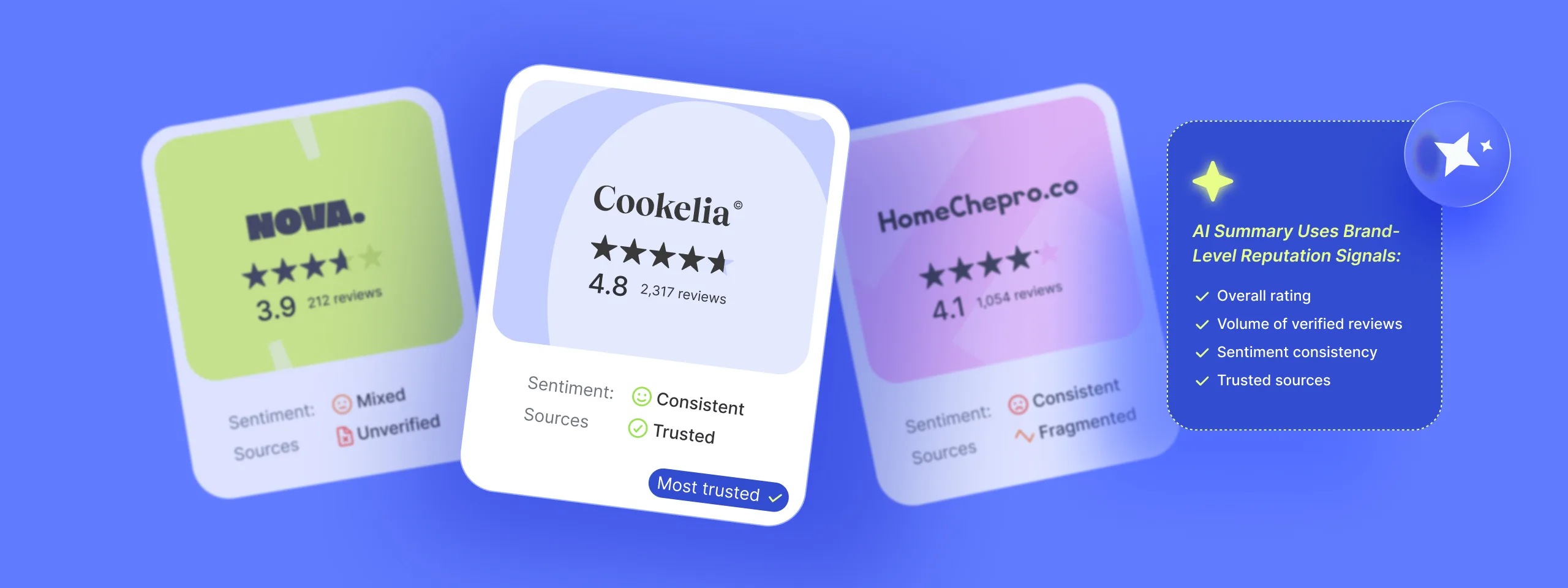
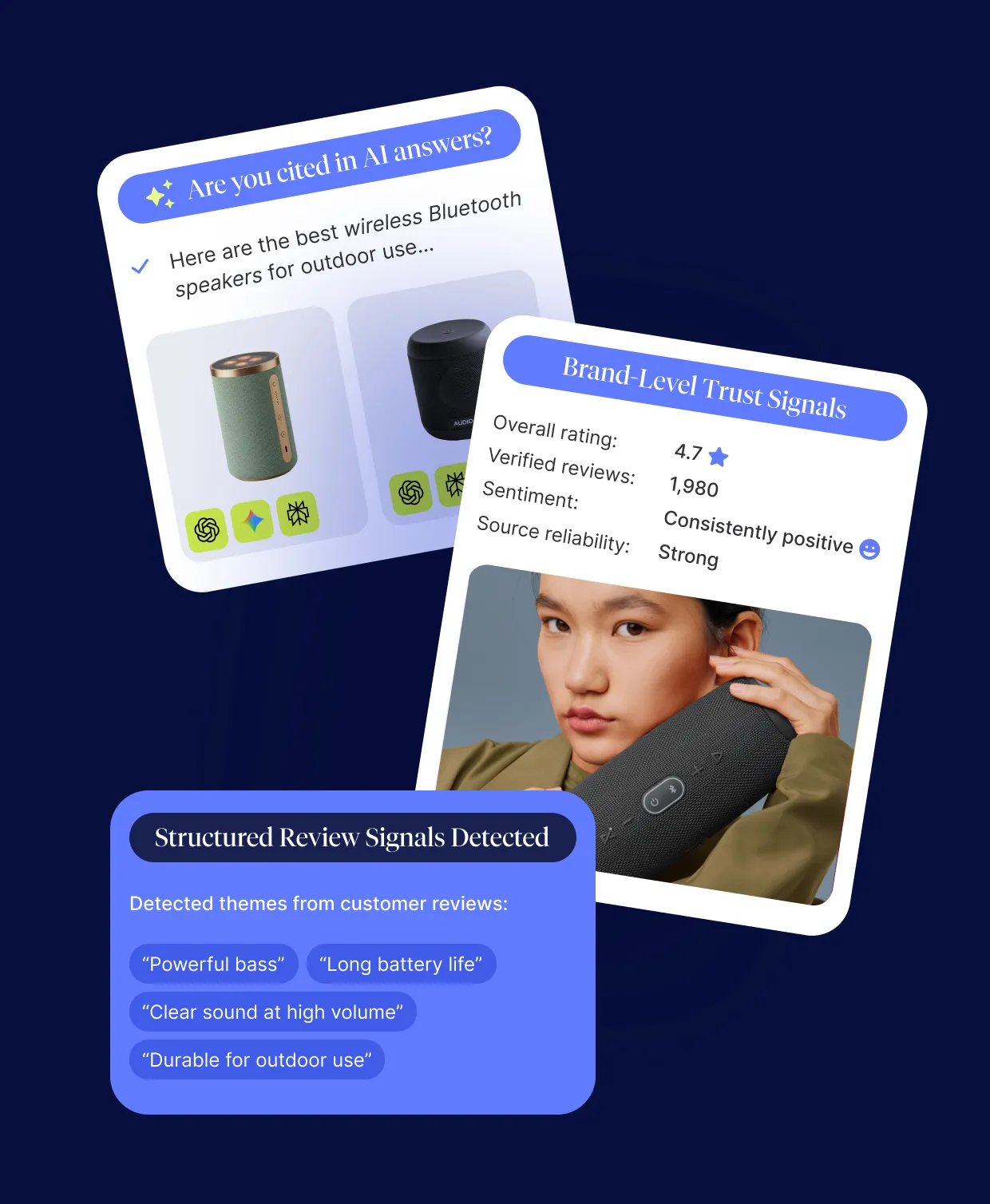
AI-generated summaries frequently begin with brand credibility signals:
- Overall rating
- Volume of verified reviews
- Sentiment consistency
- Source reliability
When AI systems synthesize comparisons, they favor trusted third-party sources. Brand-level review pages hosted and structured correctly increase your probability of inclusion in generative answers.
“Share of summary” depends on source authority.
Verified, structured brand review pages strengthen that authority.
SEO Impact of Ranking for “Reviews + Brand” Queries
Brand review intent remains high-value and conversion-driven.
Verified Reviews’ by Skeepers certification pages are optimized to rank on queries such as: “Brand name reviews”, “Is Brand name reliable?”, “Brand name rating”.
This ensures visibility during high-intent research, control over brand reputation narrative, structured signals for AI ingestion.
SEA Impact with Google Seller Ratings
Google Seller Ratings display your average star rating and review count directly in Google Ads search campaigns.
Why this matters in a zero-click context? Ratings appear before the user clicks, trust is established instantly, and ads visually stand out from competitors
Eligibility requires minimum review thresholds, trusted partner integration, compliance with Google standards.
Verified Reviews by Skeepers is one of the limited official global Google Seller Ratings partners..

Product Reviews Turn Product Pages into AI-Ready Answers
In a generative search environment, product reviews become the primary source material AI engines use to construct answers.
When a consumer asks a nuanced question about durability, fit, skin type, budget, performance, or comparisons, AI systems do not rely solely on brand descriptions. They scan patterns within reviews to identify recurring strengths, weaknesses, and contextual use cases.
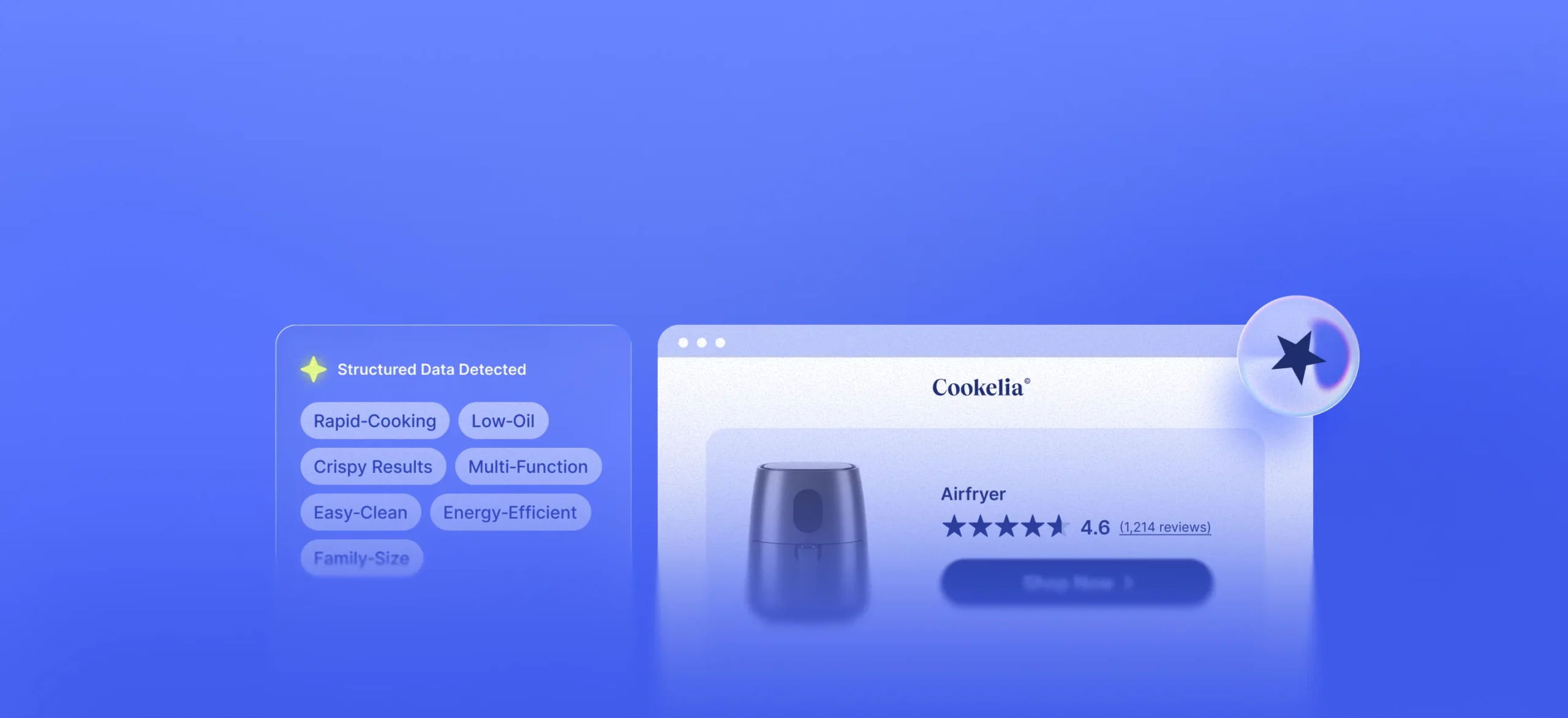
Structured correctly, product reviews become machine-readable product truth.
Rich Snippets and Structured Reviews as AI-Readable Signals
Traditional product pages were designed for humans.
AI-powered discovery requires pages that are readable by machines.
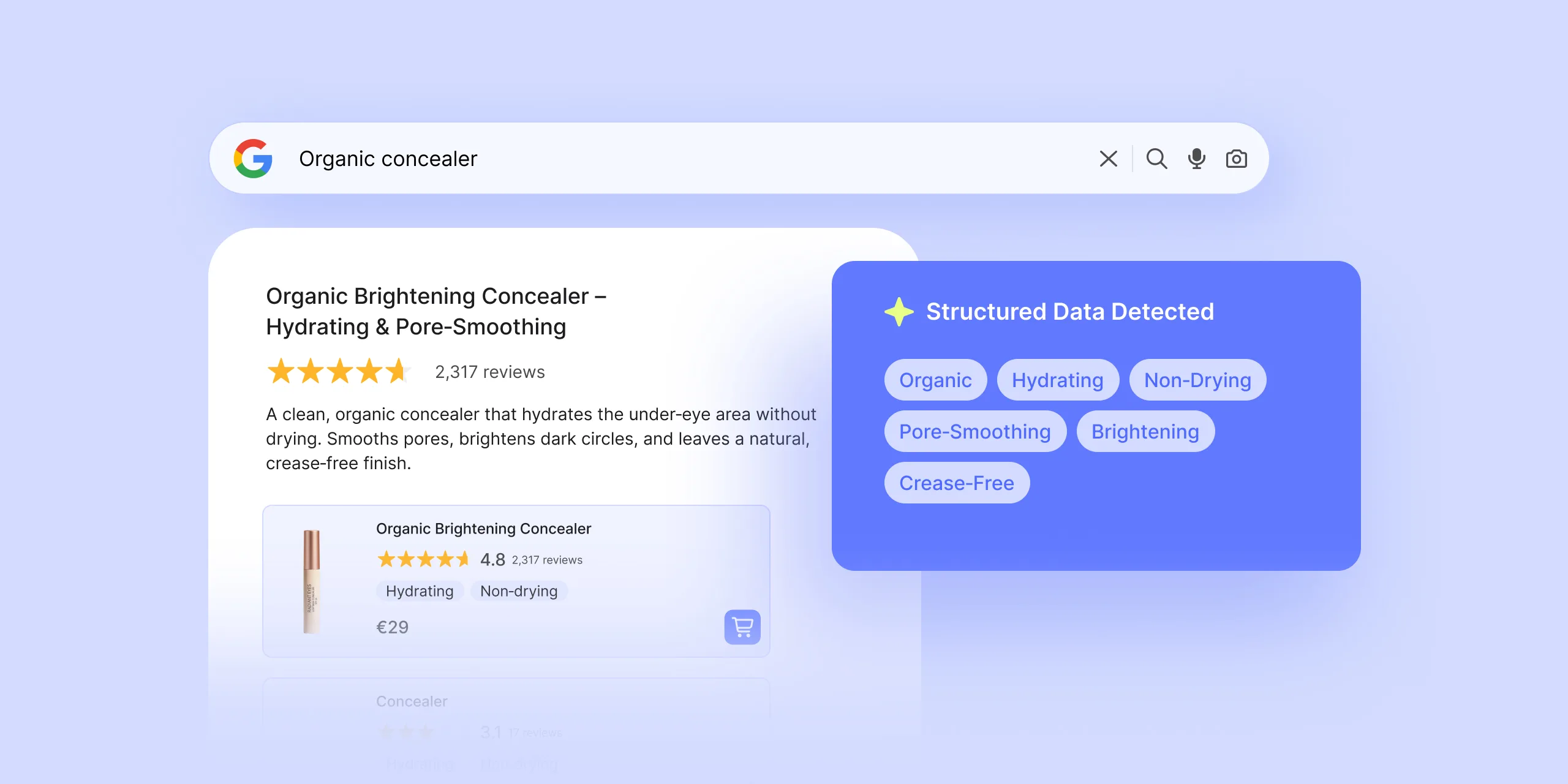
Structured product reviews enable enhanced visibility in search results through rich snippets including star ratings and review counts directly in the SERP. But their value goes far beyond visual enhancement.
When reviews are marked up with proper schema and embedded consistently across product pages, they send clear semantic signals. AI systems can detect patterns: repeated praise for comfort, recurring concerns about sizing, consistent mentions of durability, or use cases tied to specific lifestyles.
This is why structured reviews increase selection probability in generative answers. Reviews naturally contain long-tail, conversational language the same language consumers now use when interacting with AI tools. Instead of optimizing only for keywords, brands benefit from thousands of micro-phrases that reflect real questions and lived experience.
Product reviews transform static product pages into living, continuously updated data sources. In a GEO environment, that dynamism matters.

The Google Shopping Impact: From Visibility to Credibility
Product reviews also play a decisive role in shopping environments.
In Google Shopping whether through free listings or paid placements such as Product Listing Ads and Performance Max, star ratings often appear directly within the product card. This changes how products compete.
Before a user clicks, they see social proof.
Before they compare prices, they compare trust.
Star ratings increase perceived credibility at the moment of visual scanning. Even without a click, they influence which products are shortlisted. In a zero-click world, that early validation is critical.
PoS Reviews Control
Local Reputation
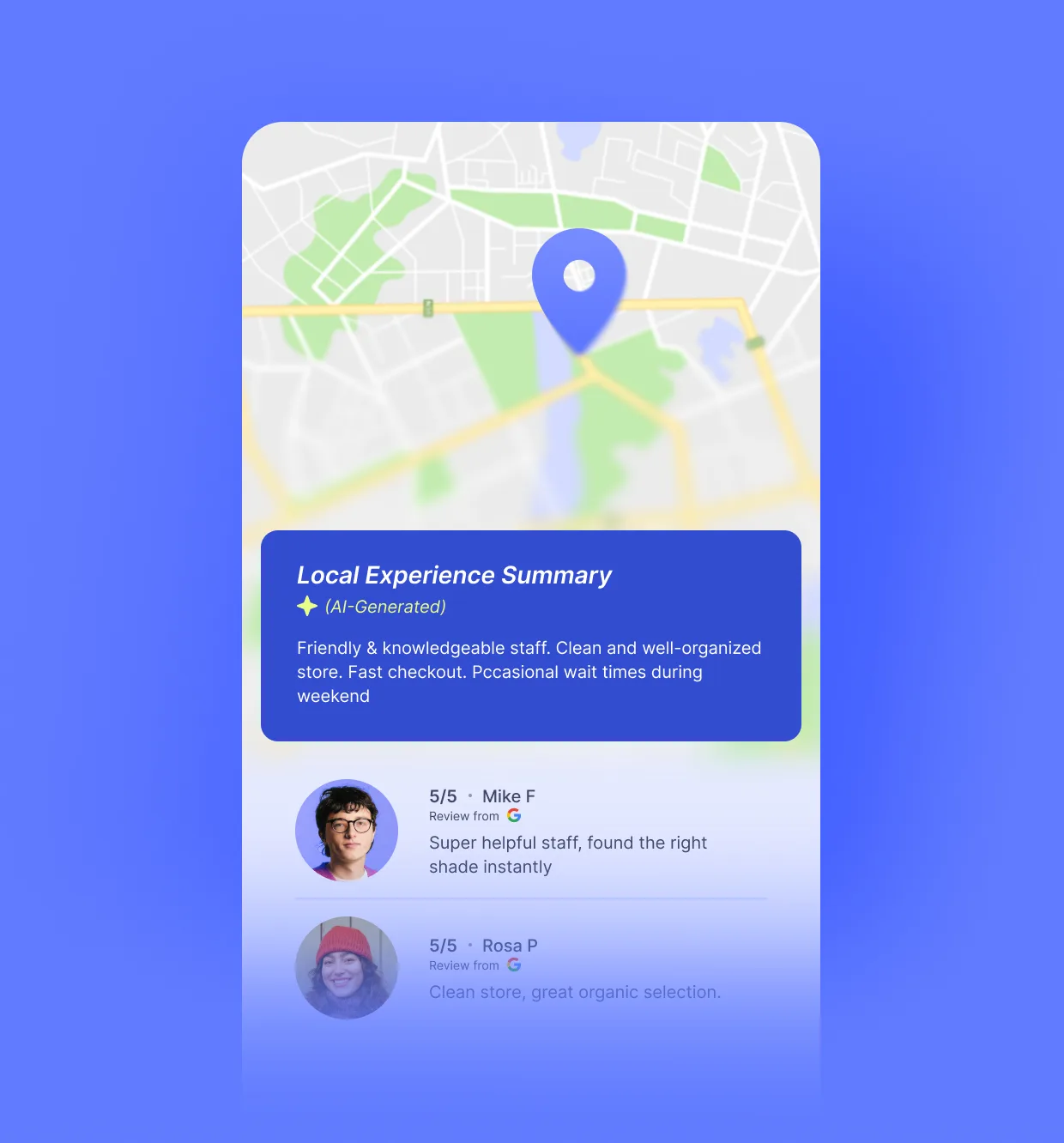
With AI-generated overviews increasingly embedded in search and map interfaces, consumers are presented with condensed narratives about store experience before they ever click. Store-level reviews now influence whether a location appears reliable, responsive, and worth visiting, often in a single synthesized paragraph.
In this context, point-of-sale reviews are visibility assets.
Why Local Experience Summaries Are Reshaping Store Discovery
Regulatory changes such as the Digital Markets Act have diversified the sources that can influence local visibility. Third-party platforms, directories, and alternative review providers now play a larger role in shaping how local reputation is surfaced.
At the same time, AI Overview and conversational search interfaces are beginning to summarize local experiences directly. Instead of reading dozens of individual comments, users may see a short description highlighting:
- Overall service quality
- Frequently mentioned strengths
- Recurring complaints
- Perceived operational reliability
This changes the dynamics of local competition.
A location is no longer competing solely on proximity and star ratings. It is competing on narrative clarity and sentiment consistency.
If your local reviews are fragmented across platforms, outdated, or inconsistently structured, AI systems may construct a summary that does not fully reflect your brand’s strengths.
Local reputation is no longer just about having a high average rating.
It is about influencing the story AI tells about your store.


05
The Business
Impact of GEO
GEO is a revenue driver.
As discovery collapses into AI-generated summaries and zero-click journeys, brands that structure, verify, and scale their consumer content gain more than exposure they gain efficiency.
The shift from ranking to selection affects how quickly buyers decide, how much you spend to acquire them, and how durable your brand advantage becomes.
Faster Buying Cycles
When AI engines summarize product strengths, compare alternatives, and validate reputation in a single interface, the traditional evaluation phase shrinks dramatically.
Consumers no longer need to open multiple tabs, compare dozens of product pages, read 40+ reviews manually.
The validation layer is condensed into seconds.
For brands, this translates into shorter time from discovery to decision, reduced drop-off during consideration, higher momentum toward purchase.
From a leadership perspective, this increases revenue velocity accelerating the conversion path without necessarily increasing traffic volume.
GEO does not just influence who sees you.
It influences how quickly they decide.


Reduced Friction to Checkout
In zero-click environments, friction is eliminated earlier in the journey.
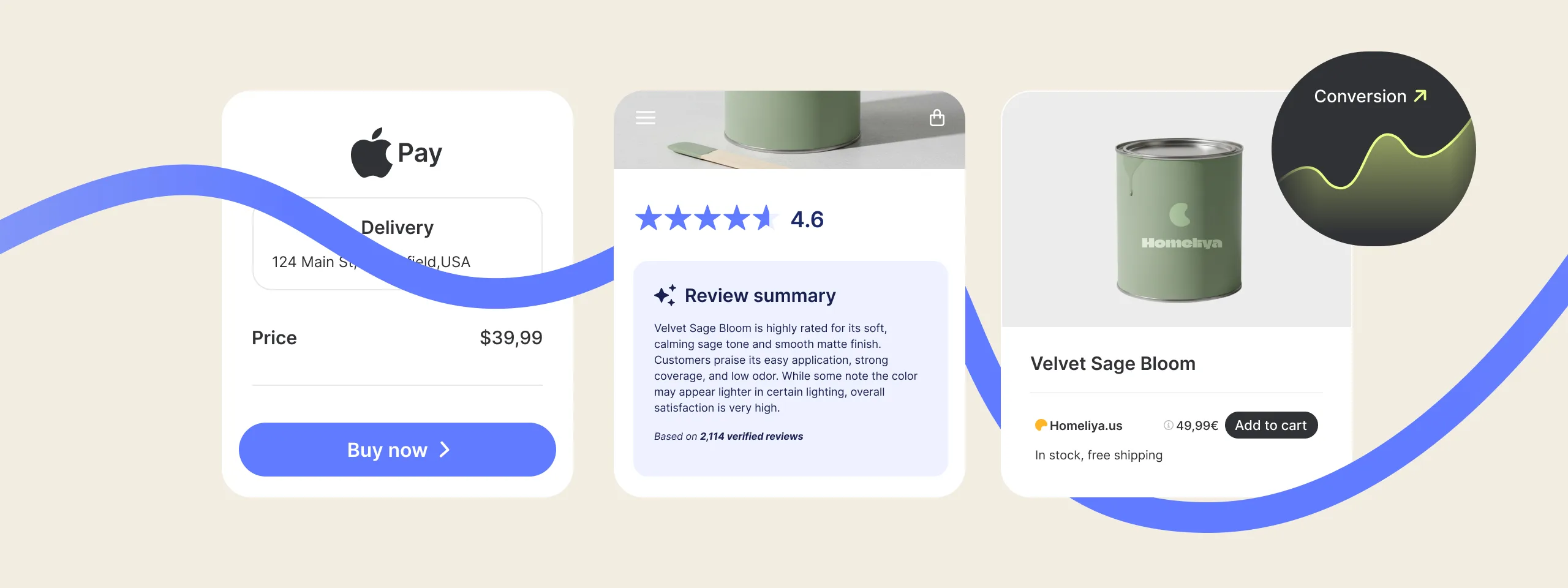
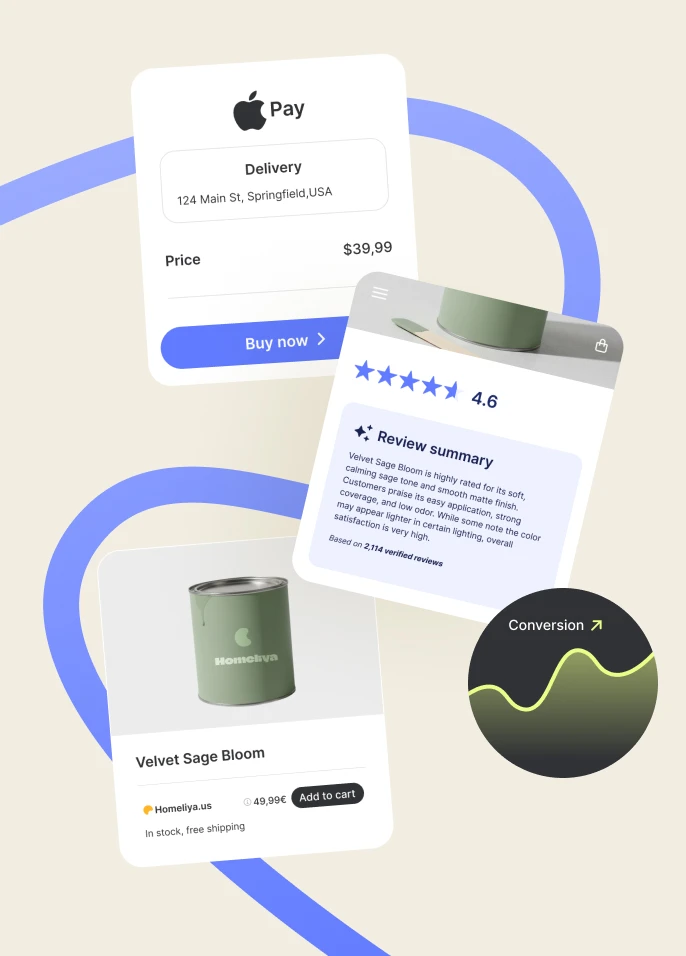
Trust signals like ratings, summaries, pros and cons appear before the click. By the time a consumer reaches a product page or marketplace checkout, confidence is already established.
This reduces hesitation at checkout, abandonment during comparison, dependence on retargeting cycles. Over time, this can lower acquisition friction and reduce the need for heavy remarketing investment.
When validation happens upstream, performance improves downstream.
Trust is now delivered in summary form.
AI engines surface aggregate ratings, recurring strengths, experience themes, and reputation signals. Brands with structured, verified, and distributed review ecosystems are more likely to have their strengths reflected accurately in these summaries.
This creates a compounding trust effect where AI selects credible sources, consumers see consolidated validation, and brand authority increases with each exposure.
Trust becomes embedded in discovery not added later through persuasion.
This builds long-term brand equity, a trust moat that becomes harder for competitors to replicate without comparable review depth and structure.
Higher Conversion Without Extra Clicks
Zero-click does not mean zero influence.
Even when users do not visit your website immediately, exposure inside AI summaries shapes perception and shortlist inclusion.
Brands that appear frequently in generative answers gain higher inclusion in consideration sets, stronger assisted conversion impact, and improved performance when users eventually click.
Over time, this can reduce reliance on aggressive paid bidding strategies and lower blended customer acquisition cost (CAC).
If your brand is cited before the click, the click becomes more valuable.


06
How to Prepare for the Zero-Click Commerce
The question is no longer whether AI will influence purchase journeys, but whether your brand will be visible inside those journeys.
Preparing for GEO does not require a complete reinvention of your strategy. It requires tightening and structuring what already exists: your review ecosystem, your content governance, and your cross-team alignment.
Here is where to start.
Audit Your AI Visibility
Before building anything new, assess where you stand today.
Start by asking:
- Are you cited in AI-generated answers for category-level queries?
- When you ask AI tools about your product category, which brands appear?
- Which sources are referenced: marketplaces, forums, review platforms, editorial sites?
- If your brand is mentioned, where does the information come from?
- Is it pulling from your structured review pages?
- Or from third-party platforms you do not control?
Then evaluate your ownership layer:
→ Do you have structured, schema-marked review content that is machine-readable?
→ Are your brand, product, and local reviews consistently formatted and distributed?
→ Is your review content fresh enough to be considered relevant?
Strengthen Your Review & UGC Infrastructure
Once visibility gaps are identified, the priority becomes operational discipline.
Always-On Collection
GEO rewards recency and consistency. Implement continuous review collection through:
→ Post-purchase automation
→ Lifecycle triggers (delivery confirmation, usage milestones)
→ Store-level feedback flows
The goal is sustained velocity.
Format Expansion
AI engines synthesize patterns across formats. Text alone limits richness.
Encourage customers to contribute:
→ Written reviews
→ Star ratings
→ Photo uploads
→ Short-form videos
Visual UGC strengthens authenticity signals and enhances both SEO and shopping placements.
Verification and Moderation as Trust Signals
In an AI-first ecosystem, provenance matters.
Ensure:
- Reviews are verified
- Moderation is transparent
- Compliance standards are visible
- Response management is active
Verification is no longer only a compliance requirement.
It is a visibility multiplier.
07
Conclusion
Online discovery has entered a new phase.
Generative AI, regulatory pressure, and zero-click behaviors are reshaping how consumers evaluate and choose brands. Traffic alone is no longer the defining measure of digital performance. Selection inside AI-generated answers is.
In this environment, reviews and UGC move from conversion support to strategic infrastructure. They power the summaries, comparisons, and credibility signals that influence decisions before a click ever happens.
When reviews are structured, verified, and continuously distributed, brands will gain:
- Faster buying cycles
- More efficient acquisition
- Stronger brand equity
- Greater resilience in algorithmic shifts
SEO made brands visible.
GEO makes them selectable.
