








UGC Trends 2026: The Convergence of AI, Creators, Communities, and Commerce
Discover Index
Index
Afficher plus
Afficher moins

How to Build a UGC Strategy That Algorithms Actually Reward?
 16
mn
16
mn
par
Asmita


There has never been more content, and there has never been less trust in it. AI can spin up a thousand product descriptions before lunch, which is exactly why a real person’s honest take is suddenly the scarcest thing in the feed. That scarcity is the opportunity. A UGC strategy built on real customer and creator voices is now how brands win attention from audiences and from the algorithms that decide what those audiences see.
This guide is operational: a working definition, why platforms reward real content, the performance case in CAC and ROAS terms, a seven-step strategy, and the mistakes that quietly sink most programs.
A UGC strategy is a repeatable system for sourcing, licensing, managing, and distributing real customer and creator content at scale. It treats user-generated content (UGC) as marketing infrastructure, not a lucky byproduct.
• Built on credibility, the scarce resource in an AI content glut.
• Rewarded by Google, TikTok, and Amazon ranking systems.
• Lowers CAC and lifts ROAS when reused as paid creative.
• Needs clear goals, usage rights, and clear metrics from day one.
Trust is the new scarce resource
The strategic shift, in one line: the only bottleneck used to be producing content. Now brands also have to worry about that content being trusted. When anyone can mass-produce polished copy, polish stops signaling quality. What cuts through is the fingerprint of a real person who used the thing. Audiences have grown skeptical, and so have the platforms ranking the content.
Why AI-generated content made authenticity scarce
Generative tools flooded every channel with competent, forgettable posts. When the supply of generic content races toward infinity, its value falls toward zero. The signals that cannot be faked, real customers and real usage, become disproportionately valuable. That is why real user-generated content is the asset worth building a strategy around: it is scarce by definition.
Algorithms are shifting from volume to credibility signals
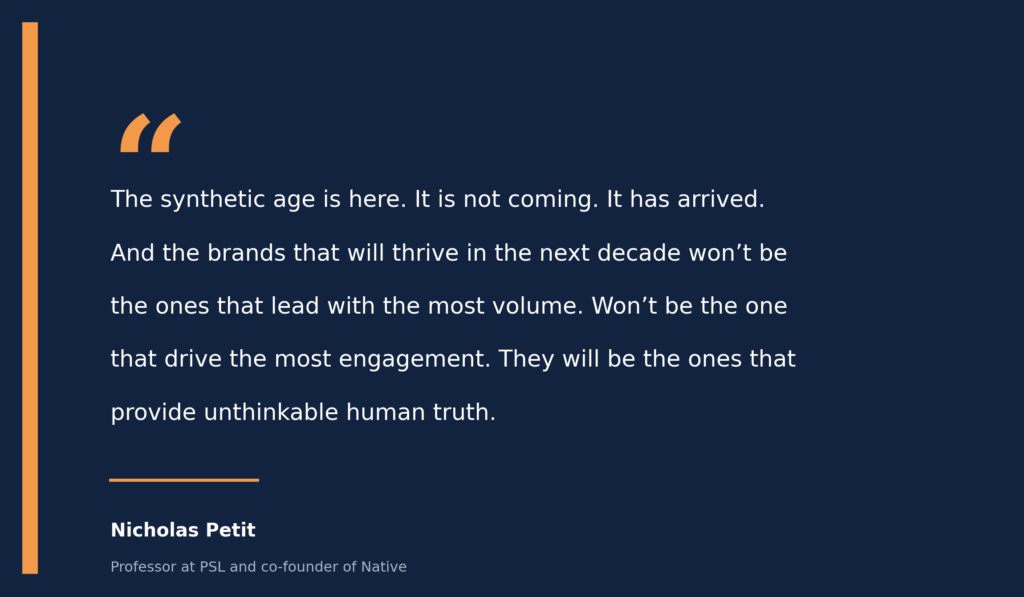
For years the game was frequency. Post more, rank more. That era is closing. At Skeepers’ UGC Summit, Nicolas Petit, Professor at PSL and co-founder of Native, argues, ranking systems now reward credibility over raw volume, weighting engagement rate and real experience more heavily than output.
Watch the major platforms and the pattern holds: Google leans on experience and trust, the short-video feeds reward content people actually watch. The common thread is an algorithm tuned to detect the real thing.
What a UGC strategy actually is
A UGC strategy is the structured, always-on version of user-generated content. Instead of waiting for the occasional happy customer to post, you build a system: clear goals, a sourcing engine, briefs that guide without scripting, documented rights, a central library, and a distribution plan across organic, paid, and retail. The shift is mindset: you stop treating UGC as a lucky byproduct and start treating it as infrastructure.
Strategy vs. one-off UGC campaign
A one-off campaign is a burst: a hashtag push, a single creator drop, a contest. It spikes engagement for a week, then stops. A UGC strategy is the difference between a fireworks show and a power grid. The campaign makes a moment; the strategy makes a steady supply you can forecast, measure, and scale.
Operationalizing the “voice of the customer” as a growth engine
Most brands sit on a goldmine they never mine: what customers actually say, in reviews, DMs, and creator content. A UGC strategy captures the voice of the customer systematically and feeds the real language, benefits, and objections into product pages, ads, and briefs. The voice of the customer stops being a slide quote and becomes fuel for conversion.
Why algorithms reward authentic UGC across Google, TikTok, and Amazon
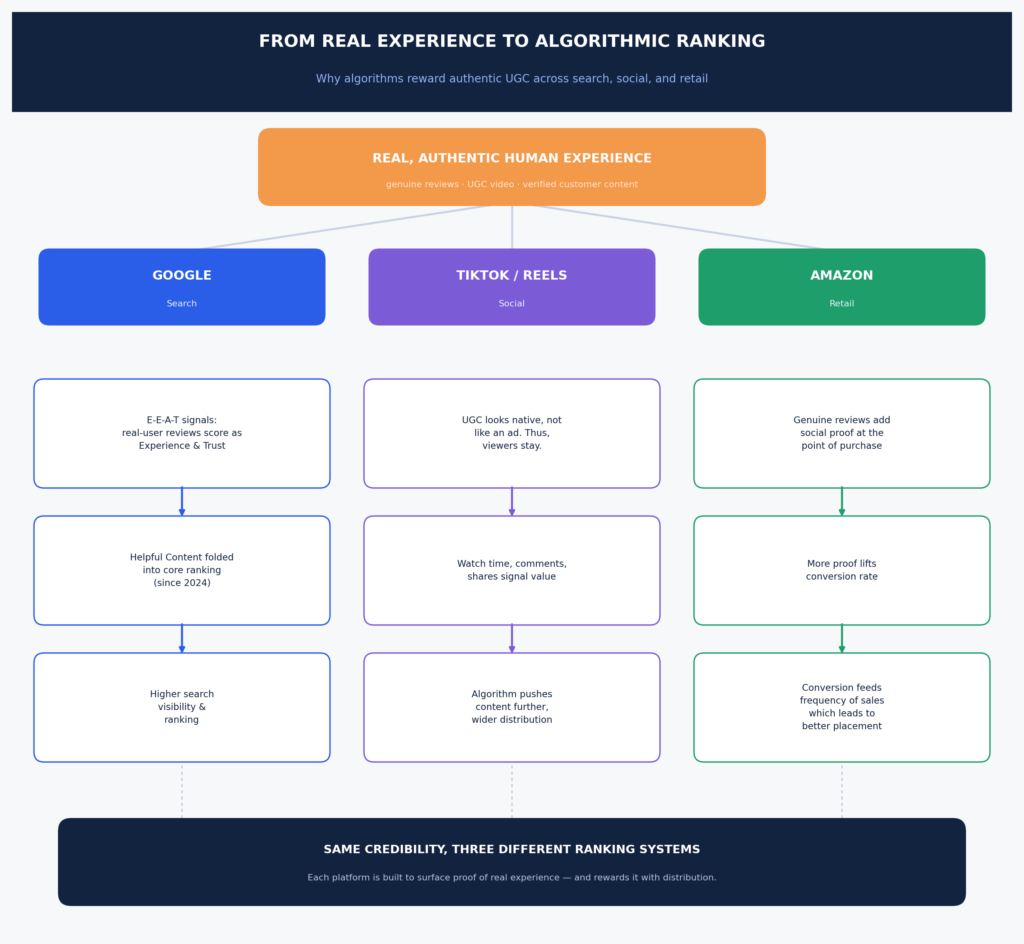
The core argument: the same credibility that wins human trust now wins algorithmic distribution, on three different platforms, for one reason. Each is built to surface proof of real experience.
Google: reviews, helpful content, and E-E-A-T signals
Google folded its Helpful Content system into core ranking in 2024 and pushed Experience to the front of its quality framework. Per Google’s guidance on people-first content, a review from someone who actually used a product outranks one written without that experience. That is E-E-A-T in practice: customer reviews and genuine UGC are trust signals. Instagram posts now surface in Google too, extending the reach of real social content.
TikTok and Reels: native format, watch time, and velocity
On Instagram Reels and TikTok, the system optimizes to keep people watching. UGC video wins because it looks native, not like an ad, so viewers stay. Watch time, comments, and shares tell the algorithm to push it further. Velocity helps: many creators producing many variations means more shots at a winning hook, and frequency itself earns reach.
Amazon and retail: review volume drives retail velocity and rankings
On retail listings, the mechanism is straight-forward. Review volume and quality move conversion and search ranking together. More genuine reviews mean more social proof at the point of purchase, which lifts conversion, which feeds retail velocity, which improves placement. It compounds: a steady stream of reviews climbs while listings without them stall.
UGC as a performance marketing multiplier
The reach case is nice; the money case earns the budget. Reused as paid creative, real content multiplies returns.
Lower CAC by reusing UGC in paid ads
Native, phone-shot creative beats studio ads on cost and engagement. Run UGC in your paid social campaigns and the results shows up directly: campaigns using UGC report cost per acquisition often 25% to 40% lower than produced assets, per aggregated UGC benchmarks. People click what feels like a recommendation, not an interruption. That is the win.
Higher ROAS: authentic creative outperforms produced content
The same dynamic lifts return on ad spend. UGC drives engagement several times higher than brand-made content, with conversion lifts well into the triple digits on product pages. Credibility earns trust, trust lowers the cost of persuasion, and cheaper persuasion at equal revenue is a higher return. The creative that feels least like advertising tends to advertise best.
Compounding SEO and conversion advantage over time
Campaigns spike and fade. A strategy compounds. Every review and clip keeps working: ranking on Google, converting on the page, fueling the next ad. Over months that builds a moat rivals cannot quickly copy.
See how Skeepers helps brands produce licensed UGC video at scale, ready for organic and paid.
See UGC video at scale with Skeepers
How to build a UGC strategy in 7 steps
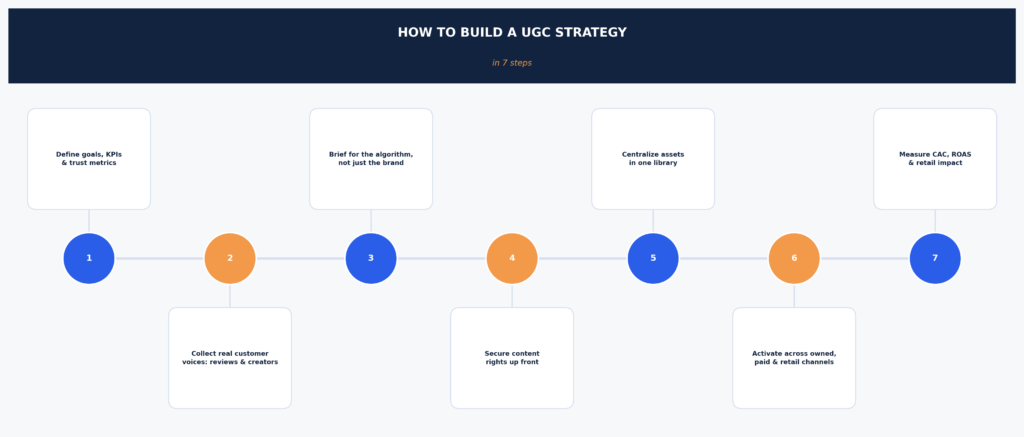
Enough theory. Here is the build, in the order that works. The discipline is in doing all seven, not the three that feel easy.
1. Define goals, KPIs, and the trust metrics that matter
Start with one primary goal and the metrics that prove it, including engagement rate and conversion lift. Awareness, conversion, or ad-creative supply each point to different content. Set those metrics before launch so every later call is judged against them.
2. Systematically collect real customer voices: reviews and creators
Build a sourcing engine, not a wishlist. Combine two streams: customer reviews captured at scale, and UGC creators who fit your niche, starting with nano and micro tiers who post often and have the highest engagement rates.
3. Brief for the algorithm, not just the brand
Write a creative brief that sets tone, brand guidelines, and key messages while leaving room for native creativity. Over-scripting kills the credibility that makes content rank. Brief the hook, the format, the must-mention points, then step back.
4. Secure content rights up front
Get explicit, documented rights before anything goes live, even for public posts. The cleanest approach builds permission into the agreement or platform workflow. Without rights, an asset stays stuck where it cannot be boosted.
5. Centralize assets in one library
Scattered files are where ROI goes to die. Centralize every asset in one tagged content library with rights status attached. A real content library turns a pile of clips into a searchable, deployable inventory.
6. Activate across owned, paid, and retail channels
One asset, many placements. Push content across owned channels, product pages, email, paid social, and retail listings. The more surfaces a single clip touches, the more value you pull from it. This is where you repurpose winners as paid creative.
7. Measure CAC, ROAS, and retail impact: stop undervaluing UGC
Multi-measurement is key here. EMV, engagement and impressions can be early indicators which content you should put spend behind. Compare cost per acquisition and return on ad spend for UGC creative against produced content, track conversion lift on UGC-backed pages, and watch retail velocity. Feed results back into sourcing. Most teams undervalue UGC because they never measured it properly.
Case study: how Peace Out Skincare turned UGC into retail performance
Proof beats theory. Peace Out Skincare, a US beauty brand, treated user-generated content as a performance channel, mobilizing a community of micro-tier creators for a steady flow of native content.
The payoff was not just engagement. By sourcing creators, securing rights, and reusing content across social and retail, the brand turned real UGC into measurable retail performance, the outcome a one-off campaign cannot manufacture. It is the seven-step strategy, run for real.
Common UGC strategy mistakes to avoid
First, over-scripting: brands so anxious about control that they cram the creative brief with brand guidelines and rules, taking the realness out of the content, so it looks like an ad and ranks like one. Second, ignoring rights until too late, trapping great clips on a creator’s account. Third, treating UGC as free, then never resourcing the sourcing and tracking that make it scale. Fourth, the quiet killer, failing to measure, so UGC stays undervalued while produced content keeps eating the budget. Dodge those four and you are ahead of most.
Scaling an authenticity-first UGC strategy with Skeepers
All of this is doable by hand at small volume. Then you scale, and the slow steps, sourcing, licensing, organizing, tracking, become a full-time job that crowds out the strategy. Skeepers Influencer Marketing closes that gap: a vetted community, creator matching on fit and engagement, rights captured in the workflow, and results in one place. The aim is not to industrialize credibility until it feels manufactured, but to remove the manual drag so the real part can scale.
Vetted nano/micro community, licensed UGC video, and data-powered influencer strategy
The pieces that break manual programs are the ones handled for you: a pre-vetted community of micro-tier UGC creators, licensed UGC video that is ad-ready by default, and creator selection driven by data, not guesswork. Pair it with a gifted reviews strategy and one engine feeds both your social proof and your retail listings. One system, real content, measurable output.
Ready to turn customer and creator voices into a performance engine?
Related articles
FAQs
What is a UGC strategy?
A UGC strategy is a repeatable system for sourcing, licensing, managing, and distributing customer and creator content at scale.
A UGC program is the structured, always-on version of user-generated content. Instead of relying on the occasional customer post, a brand sets up a system: clear goals, a sourcing engine for creators or customers, briefs that guide content without scripting it, documented usage rights, a central library, and a distribution plan across organic and paid channels. The strategy treats UGC as marketing infrastructure rather than a lucky byproduct. That shift matters because sporadic mentions can’t be forecast, measured, or scaled, whereas a program produces a predictable flow of authentic assets you can deploy on product pages, in ads, and across social. The strongest programs also build in measurement from day one, so every asset can be tied to engagement and conversion outcomes.
How do you build a UGC strategy from scratch?
Set goals, source the right creators, brief them, secure rights, centralize assets, distribute, then measure and iterate.
Building a UGC straetgy from scratch follows seven steps. First, define one primary goal and the KPIs that prove it. Second, source creators who fit your niche and audience, starting with nano and micro tiers that post often and convert. Third, write a brief that guides tone and key messages while leaving room for native, platform-appropriate creativity. Fourth, secure content rights up front, in writing, so every asset is usable in ads. Fifth, centralize all incoming content in one tagged library to avoid scattered files and compliance gaps. Sixth, distribute across owned channels, product pages, email, and paid social. Seventh, measure performance against your KPIs and feed the results back into sourcing and briefing. A platform that handles sourcing and licensing collapses the slowest steps.
Why do social algorithms favor UGC?
UGC is native, authentic, and high-velocity, which drives the watch time and engagement that TikTok and Reels reward with reach.
Social algorithms optimize for content that keeps users on the platform, and UGC tends to do exactly that. It looks native to the feed rather than like a polished ad, so viewers keep watching instead of scrolling past. That watch time, plus comments and shares, signals quality to ranking systems on TikTok and Instagram ,which respond with more distribution. UGC also lets brands publish at higher velocity: many creators producing many variations means more chances to find a winning hook, and frequency itself is rewarded. Finally, authentic creator content generates the kind of genuine engagement, real comments and saves, that algorithms weigh heavily. A UGC program built for these signals, native format, volume, and authenticity, earns organic reach that brand-produced ads rarely match.
What’s the difference between a UGC strategy and influencer marketing?
A UGC program is about producing usable content assets; influencer marketing is about accessing a creator’s audience and reach.
The two overlap but optimize for different outcomes. Influencer marketing pays for access to a creator’s audience: the value is the reach, credibility, and distribution that come with their following. A UGC strategy optimizes for the content itself: the deliverable is a library of authentic assets the brand owns the rights to and can deploy anywhere, from product pages to paid ads. In a UGC program, follower count is almost irrelevant; what matters is content quality, niche fit, and licensing. Many mature brands run both: influencer partnerships for reach moments like launches, and an always-on UGC program for a steady stream of creative. The clearest signal you need a program rather than one-off influencer deals is when your paid social team is starved for fresh, native creative.
How do you get content rights for UGC?
Get explicit, documented consent up front, ideally with licensing built into the brief or platform workflow.
Getting content rights for UGC means securing explicit, documented permission before you reuse anything, even if the original post is public. The cleanest approach is to agree on usage up front: state in the creator brief or agreement how the content can be used, for how long, and on which channels, including paid ads. For organic customer content you want to repost, request rights directly and keep a record of the approval. Crediting the original creator builds goodwill and encourages future contributions. At scale, manual permission chasing breaks down, so brands use platforms that capture licensing as part of the creation workflow and store consent metadata alongside each asset. Without clear rights, content stays stuck on the creator’s account and can’t be boosted, which is where most of UGC’s ROI actually comes from.
How much does a UGC strategy cost?
Mostly product, fees for paid UGC creators, and tooling, far less per asset than studio-produced content.
A UGC strategy’s cost has three main components: product or gifting, creator compensation for paid UGC, and the tooling to source, license, and manage content. Gifted UGC keeps direct costs to product plus shipping, while paid UGC creators typically charge per video, often a fraction of a studio shoot or a macro-influencer fee. Tooling or platform costs cover sourcing, rights management, and analytics. The reason programs pencil out is cost per asset: a single brand studio video can cost more than a batch of UGC videos that you can A/B test as ads. The hidden cost is operational time, vetting creators, chasing rights, organizing files, which is exactly what a dedicated platform reduces. Budgeted against the volume of usable, ad-ready creative it produces, a UGC program is one of the lowest cost-per-content channels available.
How do you measure UGC program success?
Track engagement, conversion lift vs. brand content, cost per asset, post velocity, and reuse rate.
Measuring a UGC program means looking beyond vanity metrics to business impact. Engagement metrics, likes, comments, shares, watch time, show whether the content resonates and earns algorithmic reach. Conversion metrics matter most: compare pages or ads using UGC against equivalents using brand-produced content to isolate the lift. Cost per asset and cost per usable asset reveal efficiency, since not every piece will clear your quality bar. Operational metrics, post velocity, moderation turnaround, and reuse rate, show whether the program is actually scaling or quietly stalling. Finally, track the share of paid social creative sourced from the program, a strong sign it has become core infrastructure rather than a side project. Set these KPIs before launch so each iteration of sourcing and briefing can be judged against real outcomes.