








 Index
Index


The way B2B buyers discover information has fundamentally shifted. Google’s AI Overviews, ChatGPT, Perplexity, and Gemini are rewriting the rules of digital visibility. Brands relying solely on traditional SEO are already losing ground. Ranking at the top of a search engine results page is not sufficient. To stay visible in 2026, your brand must also earn citations from large language models (LLMs) that are becoming the first stop in the buyer journey. This guide explains what SEO for AI actually means, how GEO complements your ranking strategy, and what steps CMOs and social media managers can take to get ranked and cited.
What “SEO for AI” Actually Means in 2026 (It’s Not What You Think)
Many brands assume SEO for AI simply means adding structured markup or adjusting a few headings. In reality, it represents a dual mandate: maintaining strong performance in traditional search engines while building visibility in the outputs of LLMs such as ChatGPT, Perplexity, and Gemini. Queries that once led to a list of blue links now frequently produce a synthesized, machine-generated response drawn from a curated set of sources. If your brand isn’t among those sources, you are invisible even if you rank on page one of Google. At its core, SEO for AI asks teams to think across two optimization layers: the traditional ranking layer and the citation layer, where clarity, factual depth, and formatting determine whether a language model will draw from your pages when constructing its answer.
Traditional SEO vs. GEO: Two Strategies, One Content Plan
Traditional SEO and GEO are not competing disciplines they are complementary approaches that together form the backbone of a modern visibility strategy. Traditional SEO optimizes for search engine ranking algorithms: technical performance (page speed, mobile responsiveness), on-page elements (headings, meta tags, keyword placement), and off-page authority (backlinks, brand mentions). The goal is to rank on the SERP so users click through to your site. GEO, by contrast, optimizes for machine comprehension. It produces content that is clear, well-structured, and easy for a language model to excerpt and reuse. GEO emphasizes definitional clarity, credible sourcing, structured formats (numbered lists, tables, FAQ sections), and topical authority built across a cluster of related pages. The best-performing content in traditional SEO and GEO shares a common foundation depth, expertise, and structure.
How AI Overviews, ChatGPT, Perplexity, and Gemini Are Changing the Search Landscape
The search landscape is no longer dominated by a single platform. While Google remains the primary platform for most users, tools like Perplexity and ChatGPT are capturing a growing share of informational queriesparticularly from B2B professionals seeking fast, synthesized answers. Google’s AI Overviews now appear at the top of many results pages, summarizing key information before users scroll to organic links. Perplexity functions as a research assistant that actively cites sources. ChatGPT’s browsing mode pulls real-time data from the web. Gemini is integrated across Google’s full product suite, from Gmail to Workspace. For strategists, this means your content must be optimized for multiple platforms, not just one search engine. Each LLM applies its own source selection logic, but all share a preference for authoritative, well-structured, and factually accurate writing that directly addresses user intent.
Why Your Current SEO Strategy Is Only Half the Battle
Most businesses already have an established SEO strategy. But if that approach doesn’t account for how generated responses are displacing traditional organic listings, it is already falling behind. The brands that adapt fastest will maintain their share of voice in an increasingly machine-mediated discovery environment.
The New Search Reality: How Users Now Get Answers Without Clicking
Zero-click searches are accelerating. Under 60% of US Google searches end without a single click. As generated summaries push organic results further down the results page, that share will only grow. For B2B marketers, this creates a structural challenge. If your audience gets answers from a language model without ever visiting your website, your content must earn a citation so that even when a user doesn’t click through, they see your brand associated with the right answer. GEO was built for exactly this reality. By structuring your material to be easily extracted and synthesized, you extend your presence beyond the SERP and into the generated answers that serve as the primary interface for millions of daily queries.
What LLMs Actually Look for When Selecting Sources to Cite
Understanding what drives a language model to cite your material is one of the most valuable skills a strategist can develop. While each LLM has its own architecture, consistent patterns emerge. Authority is foundational: these systems surface sources that appear consistently in high-quality contexts, sites with strong domain authority and a regular publishing cadence are significantly more likely to appear in generated answers. Clarity drives citability: material organized with clear headings, defined terms, and direct answers is easier to parse and excerpt. Factual specificity is rewarded: data points and precise claims are the building blocks these systems use to construct responses. Topical depth signals expertise: LLMs prefer sources that cover subjects comprehensively, and a well-organized cluster of related pages signals the domain knowledge they are trained to prioritize.
The 5 Core Pillars of SEO for AI
Building a durable SEO for AI strategy requires more than isolated tactics. The following five pillars represent the core disciplines marketing teams must master to rank in traditional search engines and earn citations from LLMs. Each is actionable, measurable, and applicable across industries.
Pillar 1 — Topical Authority: Becoming the Go-To Source in Your Niche
Topical authority underpins both SEO and GEO. Rather than optimizing isolated pages for individual keywords, it is built by creating a network of material that covers every relevant dimension of a subject signaling to search engines and language models alike that your brand is a definitive source. For B2B organizations, this means building content clusters: a pillar page covering a broad topic in depth, supported by cluster articles addressing specific subtopics. The more comprehensively you cover a subject, the more likely you are to be recognized as an authority by both ranking algorithms and LLMs selecting citation sources. Topical authority compounds: brands that publish consistently on a defined set of subjects will increasingly appear in generated answers, creating a visibility loop that drives recognition and inbound traffic.
Pillar 2 — Structured, Citable Content: Writing for Both Algorithms and AI Models
Structuring your writing for citation benefits both SEO and GEO simultaneously. Citable content is organized, concise, and direct using clear headings, numbered lists, defined terms, and short paragraphs that are easy to scan by both human readers and language models. In practice, this means opening each section with a direct answer before elaborating, using definition-style phrasing (“X is defined as…”), and incorporating data with clear attribution. Definition blocks are particularly effective: they give a language model a ready-made, self-contained statement it can extract and cite directly. Structured summaries at the end of sections serve the same purpose, providing clear takeaways that generative tools can confidently excerpt.
Pillar 3 — E-E-A-T Signals: Why Trust and Expertise Matter More Than Ever
Google’s E-E-A-T framework — Experience, Expertise, Authoritativeness, and Trustworthiness, was designed to help search engine quality evaluators assess page credibility. Today, it also serves as a reliable proxy for LLM source selection: generative tools, like human evaluators, favor material from verifiably credible sources. According to a Semrush analysis of over 20,000 AI Overview citations, 84% of URLs cited also appeared in the top 10 organic results. This confirms that strong SEO and strong citation potential are closely linked, and that E-E-A-T signals author credentials, expert quotes, cited sources, and original research are now essential for brands competing in generated responses. Invest in author credibility: detailed bios, professional credentials, and links to external validation strengthen your standing with both Google and language models.
Pillar 4 — Semantic SEO: Covering a Topic Fully, Not Just a Keyword
Semantic SEO moves beyond keyword repetition to focus on meaning, context, and topical completeness. A semantically rich page uses related terms, covers the full spectrum of user intent, and addresses the questions buyers are actually asking. For citation optimization specifically, semantic depth is critical: language models understand language conceptually, so an article that thoroughly explores a topic — covering subtopics, defining terminology, and connecting related ideas is far more likely to be cited than one that repeats a target phrase without genuine depth. Practical approaches include topic cluster mapping, keyword gap analysis, and platforms like Clearscope or Surfer SEO.
Pillar 5 — Technical Foundations: Schema Markup, Crawlability, and Clean Data
Even the most expertly written material won’t rank or get cited if it cannot be properly indexed. Technical optimization remains a non-negotiable foundation for both organic rankings and GEO performance. Schema markup provides additional context to crawlers and is especially important for generative optimization, FAQ schema, HowTo schema, and Article schema help these tools understand what your pages are about and which sections are most citable. Ensure your site has a clean XML sitemap, a configured robots.txt, and no directives that block automated crawlers from accessing your pages.
How to Optimize Your Content to Appear in AI Overviews and LLM Responses
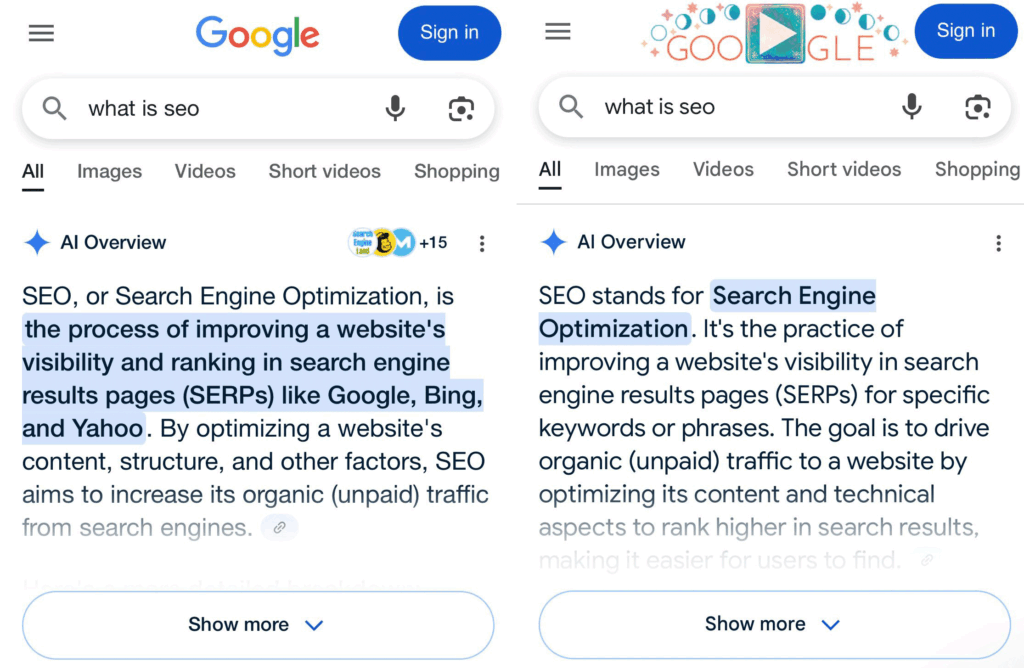
With the five pillars in place, the next step is targeted optimization for AI Overviews and LLM citations. This layer of generative optimization is where tactics become most specific and gains are most immediatelytestable.
Formatting Signals That Help LLMs Extract and Cite Your Content
Formatting is one of the most controllable levers in GEO. The structure of your writing directly affects whether a language model can extract and use it effectively. Lead each section with a direct answer these opening statements are frequently what a language model pulls first. Use numbered lists and step-by-step formats, which give generative systems structured information that is easy to process and excerpt verbatim. Write short, self-contained paragraphs that each stand alone as a discrete piece of information. Present comparison data in tables, which are both highly crawlable and frequently cited. Maintain consistent H2 and H3 headings, which help search engines and generative tools understand the hierarchy of your material.
The Role of FAQ Sections, Definitions, and Data Points in GEO
FAQ sections are among the highest-impact tools in this approach. They mirror the conversational query format used by both users and language models, making them easy to match to informational queries. A well-built FAQ, real questions as subheadings, concise factual answers beneath them, dramatically increases the chance your material appears in generated responses. Data points serve a parallel function: statistics with cited sources give LLMs concrete, verifiable claims they can confidently incorporate into answers. Pages with original research are far more valuable as citation sources than those making general claims without evidence.Explicit definitions round out the approach: when your writing clearly states “GEO is the practice of optimizing material to earn citations from large language models,” generative tools can extract that statement directly.
Measuring Success: How to Track Both SERP Rankings and LLM Visibility
As SEO for AI matures, measurement must evolve alongside it. Traditional ranking metrics such as organic traffic, keyword positions, and click-through rates remain important, but they no longer capture the full picture. Brands now need to monitor their presence in generated answers, not just traditional results pages.
Tools to Monitor Your Presence in AI-Generated Answers
Several platforms now offer dedicated LLM visibility tracking. Semrush’s AI Toolkit monitors which pages appear in Google’s generated summaries for target keywords. Manual testing in Perplexity and ChatGPT lets teams verify whether their brand appears as a cited source for high-priority queries. Social listening tools like Brandwatch can capture brand mentions within publicly shared generated responses. Google Search Console remains essential for identifying where generated summaries are cannibalizing organic traffic. Enterprise SEO platforms such as BrightEdge and Conductor have added citation visibility modules that track LLM appearance frequency alongside traditional ranking data. Building a consistent testing cadence, weekly or bi-weekly checks combined with automated monitoring gives marketing teams the evidence they need to assess whether their citation strategy is delivering measurable gains.
SEO for AI Applied to e-commerce marketing: A Practical Framework
For e-commerce brands, SEO for AI creates a compelling opportunity. Product pages, category content, buying guides, and review sections must function in a world where generated responses answer purchase intent queries before a user ever reaches your website. A practical framework starts with detailed product descriptions that a language model can extract with precision, use cases, technical specifications, and comparison data. Category-level authority pages, buying guides, trend reports, and head-to-head comparisons, establish topical depth and give generative tools a high-quality source to cite when buyers ask questions like “What is the best solution for [use case]?” Structured review data, marked up with schema, functions as a trust signal for both ranking algorithms and language models: authentic customer feedback is precisely the kind of first-party material these systems value. For brands using platforms like Skeepers, user-generated reviews and Q&As can be structured and published in formats that maximize both SEO and GEO impact, turning authentic consumer voice into a direct driver of citation visibility across search results and generated answers alike.