






UGC Trends 2026: The Convergence of AI, Creators, Communities, and Commerce
Discover Index
Index
Afficher plus
Afficher moins

What Influencer Gifting Really Is (and How to Make It Work)
 18
mn
18
mn
par
Asmita



Most brands track the wrong number. They count boxes shipped. The number that decides whether a program pays for itself is content back, and the distance between those two figures is where a lot of marketing budget quietly disappears.
Gifting is supposed to close that gap: send a creator product, earn an authentic post in return. Done well, it is the lowest cost-per-content tactic in the entire influencer playbook. Done the way most teams do it, packing boxes and hoping, it returns almost nothing. While brand awareness is still the top goal marketers chase with creators, named by 55% of respondents in the Influencer Marketing Hub benchmark and 65% among micro-influencer campaigns specifically, gifting campaigns can do even more for your brand like building a library of licensed UGC, boost SEO/GEO and increase sales due to halo effect social media has on retailers and D2C sites. Gifting can deliver that awareness in a cost effective way, with the right strategy in place.
This guide treats gifting as an operation, not a giveaway. You will get the working definition, the line that separates it from a paid deal, the FTC rules you cannot skip, the reasons campaigns fail, and a step-by-step process for getting posts back.
Gifting means sending a creator product with no payment, in the hope of earning organic content. It works on reciprocity and is most effective with nano influencers and micro influencers.
• Lowest cost-per-content tactic in influencer marketing.
• No per-post fee: the cost is product plus shipping.
• Gifted product counts as “material consideration,” so disclosure is required.
• Well-run programs see roughly 90% post rates.
• Success depends on targeting, a clear brief, and follow-up.
What is influencer gifting?
Gifting a creator manually or without an influencer marketing solution is the practice of sending a product without requiring anything in return. No contract. No guaranteed post. You ship, and you hope the creator likes it enough to share it. When they do, the result reads as genuine discovery rather than an ad, which is exactly why audiences trust it.
The mechanism is reciprocity. A creator who actually uses the product and likes it tends to talk about it, in a story, a Reel, an unboxing. Because nothing was promised, nothing feels forced. That authenticity is the whole point. It is also the reason gifting works best with nano influencers and micro influencers, who post often and treat a useful product as fair value. Send the same box to a creator with two million followers and you will most likely hear nothing.
Gifting vs. paid partnerships
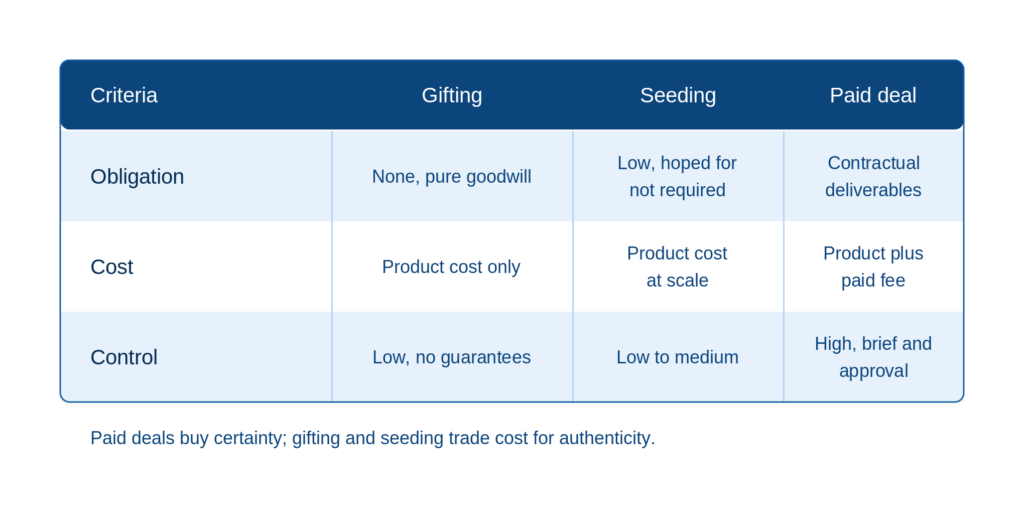
Gifting and paid partnerships serve different purposes, but they are not defined simply by whether content is expected. In a gifting campaign, creators receive products because they are a good fit for the brand, with the understanding that they are invited to share their genuine experience. Paid partnerships go a step further by introducing negotiated commercial terms, guaranteed deliverables, and specific campaign requirements. The key difference is not whether content is created, but the level of contractual commitment and creative control involved.
Gifting prioritizes authenticity by giving creators the freedom to express honest opinions in their own style, while paid partnerships offer brands greater certainty through agreed deliverables and timelines. Both approaches have a place in a creator strategy. Gifting is well suited to generating authentic user-generated content at scale, while paid collaborations are ideal when brands need guaranteed reach, specific messaging, or campaign commitments. The strongest programs often combine both, using each where it delivers the greatest value.
Why brands use influencer gifting
Brands use influencer gifting because it is one of the most cost effective ways to generate authentic content at scale. It enables them to work with nano and micro creators, who often have the highest engagement rates and the strongest connections with their audiences. At the same time, gifting helps increase brand awareness, creates a steady flow of UGC that can be repurposed across marketing channels, and fuels social media algorithms through consistent creator activity. These combined benefits make gifting a core part of many successful creator marketing strategies.
Three reasons keep gifting in the budget of serious brands.
Cost-efficient content at scale
Gifting is one of the most cost-effective ways to generate authentic creator content. Instead of paying a fee for every piece of content, brands primarily invest in the product, shipping, and campaign management. This allows them to activate many more creators within the same budget than a traditional paid influencer campaign.
While standard gifting programmes can produce widely varying results, platforms like Skeepers improve consistency by working with a vetted network of creators and matching products to people who are genuinely interested in them. This significantly increases the likelihood that gifted products result in authentic content. Rather than relying on a handful of expensive sponsored posts, brands can generate a continuous stream of user-generated content at scale while keeping costs under control. It’s no surprise that product gifting is one of the most common forms of creator compensation, second only to direct payment.
Posts that read as organic, not as ads
People have gotten very good at skipping ads. They have not gotten good at skipping a friend’s recommendation, and gifted content sits much closer to the second category. When a creator shares a product they genuinely chose to feature, the post carries a credibility that no scripted brief can manufacture.
That perceived authenticity is measurable. Nielsen has found that the vast majority of consumers trust organic, user-generated content over traditional advertising. Gifted posts tap directly into that trust. They look native to the feed, they sound like the creator, and they convert because the audience does not feel sold to. This is also why so many brands repurpose gifted posts as paid ad creative later, but more on that below.
A low-risk way to build long-term creator relationships
. Gifting is also how relationships start. You send product, a creator tries it, and now they know your brand and associate it with a good experience.
Do that consistently and a subset of those creators become brand ambassadors: people who feature you repeatedly, often without being asked, because the product earned its place in their routine. That is a far cheaper and stickier outcome than renting attention one post at a time. The relationship compounds. A creator you gifted six months ago might be the one who delivers your best-performing piece of content this quarter. It’s also a great idea to work with a subset of creators on more than one campaign. The quality of content increases since that creator already understand your brand and you know the content produced will be quality.
The FTC rules you can’t skip
Gifting feels casual. The law does not treat it that way. In the US, the FTC has spent the last few years tightening enforcement around creator disclosures, and “it was just a sample” is not a defense.
Why gifted product counts as “material consideration”
The FTC’s logic is simple. If a relationship between a brand and a creator could change how a viewer interprets a post, that relationship has to be disclosed. A gift creates exactly that relationship. According to the FTC’s Disclosures 101 for Social Media Influencers, the value of that product counts as compensation, which makes it a material connection the moment a creator talks about the brand.
That is true whether or not money changed hands, and whether or not you asked for the post. Both the creator and the brand can share liability for a missing or buried disclosure. The takeaway is not to panic; it is to be explicit. State the disclosure expectation in your outreach so creators know how to label content before anything goes live.
Which disclosures are actually compliant: #ad vs #gifted
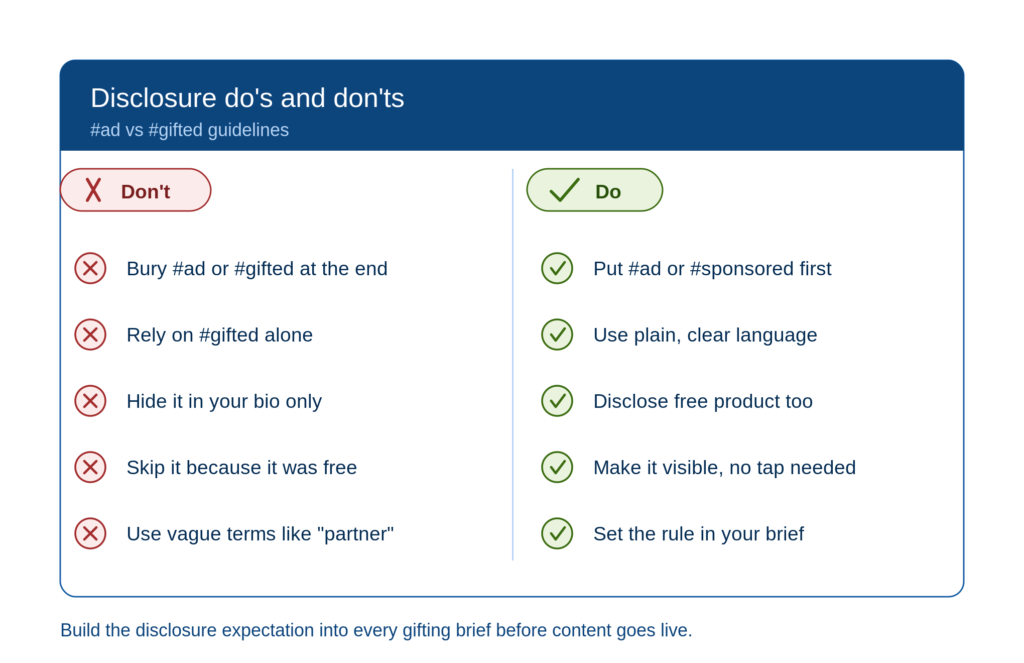
The standard the FTC applies is “clear and conspicuous,” and it has gotten stricter. A disclosure has to be unavoidable, not merely findable. Buried at the end of a caption, hidden behind a “more” tap, or parked on a profile bio? Not good enough.
Tags like “#ad,” “#advertisement,” or “#sponsored” placed up front are the safest format. Plain language works too: “Thanks to [brand] for the product” is fine if it is hard to miss. The popular “#gifted” or “#collab” alone sits in a grayer zone; the FTC has signaled these may not be sufficient on their own. So while a clean FTC disclosure does not have to be ugly, it does have to be obvious. Build the expectation into the gifting brief and you avoid the whole problem.
Brands that do influencer gifting well
What does a working program actually look like? The brands that win with gifting treat it as infrastructure, with vetted lists, consistent briefs, and a plan for what happens after the post goes live.
Seeding at scale and gifting plus affiliate
Two patterns show up again and again. The first is seeding at scale: a brand sends product to dozens or hundreds of well-matched nano influencers and micro influencers in one push.This volume produces a reliable stream of organic content. Beauty brands have made this an art.Brands like Clio Cosmetics and Peace Out Skincare turn happy buyers into a gifting community that keeps producing posts.
The second pattern pairs gifting with affiliate links. The product is still a gift and the post still optional, but the people who share get a trackable link and a cut of sales. That single addition sharpens measurement, without turning the whole thing into a paid deal.
Why most gifting campaigns fail
Now the uncomfortable part. Most boxes sent into the world produce nothing, and it is rarely bad luck. It is a handful of repeatable mistakes.
Wrong creators, vague briefs, no follow-up
Start with targeting. Ship to people chosen by follower count rather than fit, and you get silence, because the product never matched their audience. The single biggest lever in gifting is creator selection: niche alignment, real engagement rate, and audience overlap beat reach every time.
Then the brief, or the absence of one. A box with no context gives a creator nothing to react to. The bait-and-switch is worse: promise “no obligation,” then chase for posts. Creators recognize that move instantly and stop replying, sometimes across an entire shared roster. Add zero follow-up and a fully manual process nobody has time to run, and the campaign was dead before the first package shipped. [Visual : “4 reasons gifting campaigns fail” quadrant]. None of these failures are about the product. They are about operations.
See how Skeepers powers gifting at scale, from sourcing the right creators to tracking every post.
See how Skeepers powers gifting at scale
How to run a gifting campaign that gets content back
Enough about what breaks. Here is the sequence that works, built from the way the best programs actually operate. It is not complicated. It is just disciplined.
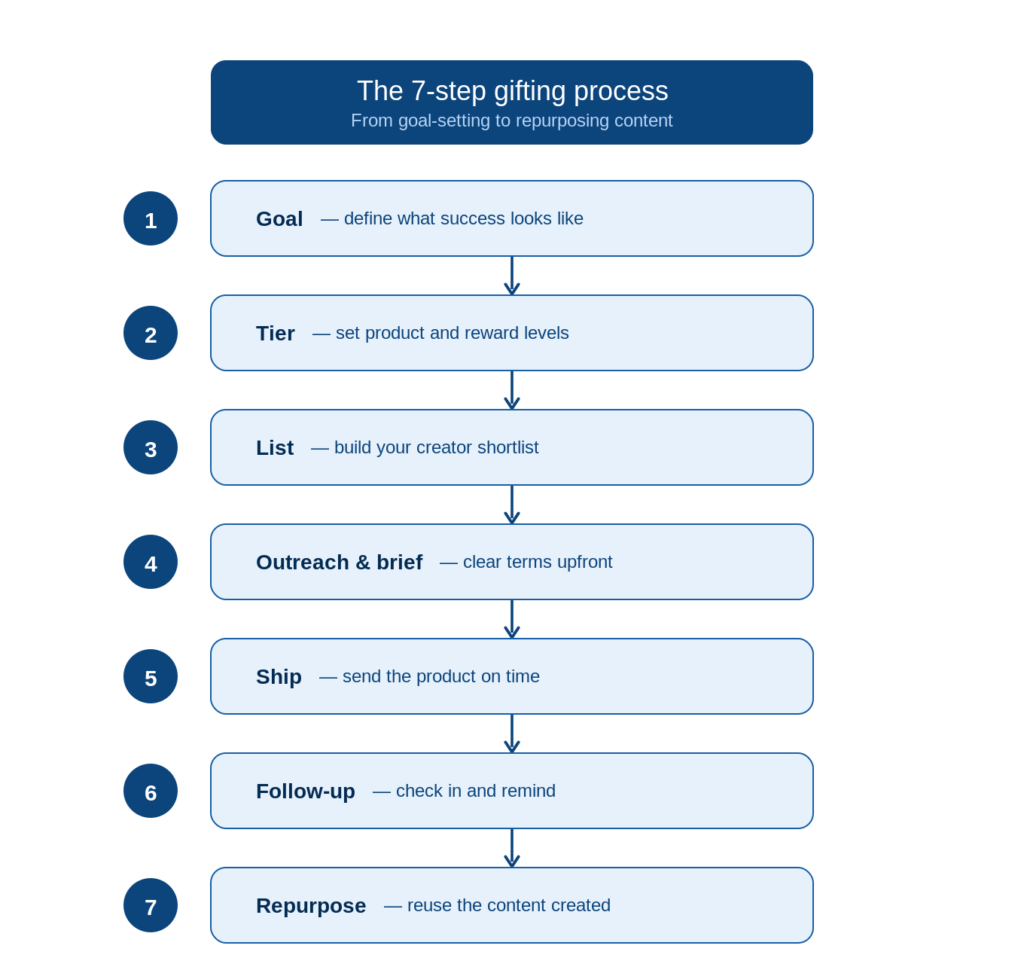
Define the goal and choose the right tier
Pick one goal before you pick a single creator. Brand awareness, content generation, or relationship building: each implies a different list and a different definition of success. Trying to do all three at once is how campaigns lose focus.
Then choose your tier. For most gifting, that means nano influencers and micro influencers, and the reason is psychological as much as economic. A gifted item already feels like fair value to a creator at that level, so the reciprocity actually fires. The same item feels trivial to a macro creator who fields gifting offers daily. Match the gift to the tier and your post rate climbs before you have done anything else.
Build a targeted nano/micro list
Now the part that decides everything. Build your list on fit, not fame. Filter candidates on three things: niche alignment with your product, a genuine engagement rate rather than a big but hollow following, and audience overlap with the people you actually want to reach.
A list of 100 creators chosen this way will beat a list of 1,000 chosen by follower count, every time. This is also the slowest, most manual step if you do it by hand, scrolling profiles and guessing at audience quality. It is exactly where a platform like Skeepers earns its keep, because a pre-vetted community removes the bottleneck that sinks most programs.
Brief, ship with a personal touch, follow up once
Reach out and brief in the same message. Keep it human. Tell the creator who you are, what you are sending, that it is a genuine no-obligation gift, two or three content ideas they can ignore, how usage rights would work if they do post, and how to handle the disclosure. That is the entire gifting brief. One message, no friction.
Then ship promptly, and add a personal note in the box. It sounds small. It is not. A handwritten line or a detail that shows you actually know the creator’s content lifts response dramatically. After that, follow up once. Not five times. One friendly nudge respects the relationship; a barrage destroys it.
Repurpose posts as paid ad creative: whitelisting and Spark Ads
The post going live is the start, not the finish. Log every piece of content and treat your best gifted posts as a creative library. The winners belong in paid media. Through TikTok Spark Ads or Instagram whitelisting, you can run a creator’s authentic post as an ad from their handle, keeping the native feel that makes it convert.
This is where gifting’s ROI really compounds. UGC-style creative routinely outperforms brand-produced ads, with research pointing to far higher click-through and meaningfully lower cost per acquisition. A box of product that becomes your top-performing ad is the whole model working as designed. Secure usage rights up front in that first brief, and the path from organic post to paid ad has no friction.
Scaling gifting without losing authenticity with Skeepers
Everything above is doable by hand at small volume. The trouble starts when you try to scale it. Sourcing, vetting, briefing, licensing, tracking: each step that was a minor chore for ten creators becomes a full-time job for three hundred, and the human element is usually the first thing sacrificed to speed.
This is the problem Skeepers Influencer Marketing was built to solve. Instead of buying reach one post at a time, brands tap a vetted community of nano and micro creators, match them to a campaign on fit and engagement rather than follower count, and keep the operational load manageable as volume grows. The point is not to industrialize gifting until it feels corporate. It is to remove the manual drag so the human part, the right creator genuinely liking your product, can happen at scale.
Vetted nano/micro community, built-in licensing and tracking
The two steps that break manual programs are licensing and tracking, and both are handled in the workflow. Usage rights are captured as part of the collaboration, so every post is ready to repurpose as an ad without a separate negotiation. And because results are tracked in one place, you can see which creators, products, and briefs actually produce content, then feed that back into the next round. The recipients who keep coming back become your brand ambassadors.
Pair that with Gifted Reviews and the same seeding motion also generates authentic, verified reviews on your product pages, not just social posts. That is gifting treated as the content and trust engine it can be, rather than a pile of boxes and crossed fingers.
Ready to turn product into a predictable stream of authentic creator content?
Related articles
FAQs
What is influencer gifting?
Influencer gifting is sending free product to a creator with no obligation to post, in the hope of earning organic content.
Influencer gifting is a tactic where a brand sends free product to a creator without requiring a post in return. It works on reciprocity: a creator who genuinely likes the product often shares it with their audience in a story, Reel, or unboxing. Because there is no contract, the resulting content tends to read as authentic discovery rather than an ad, which audiences trust more. Gifting is most effective with nano and micro influencers, who post frequently and accept product as fair value. It is the lowest cost-per-content tactic in influencer marketing, but it carries no guarantee: most boxes sent without targeting or a brief produce nothing. Brands that succeed, treat gifting as an operation, with vetted lists, clear briefs, and follow-up.
How much does influencer gifting cost?
The main cost is product plus shipping; there is no per-post fee.
Influencer gifting has no per-post fee, so the cost is essentially the product plus shipping plus a small operational lift to coordinate the send. Industry benchmarks put the value of a typical gifted item between roughly $60 and $120, though it scales with the product, from a $20 skincare item to a $2,000 mattress. The hidden cost is operational: sourcing the right creators, briefing them, and tracking results. A platform that automates sourcing and licensing keeps that cost contained as volume grows.
Does gifted content need FTC disclosure?
Yes, free product is “material consideration,” so disclosure is required.
Gifted content needs clear FTC disclosure. The Federal Trade Commission treats free product as material consideration, meaning a creator who posts about a gifted item must disclose the relationship, whether or not any money changed hands. The disclosure has to be obvious to someone scrolling quickly, so tags like “#ad” or “#advertisement” placed up front are the safest format. Vaguer tags such as “#gifted” or “#collab” alone are common in the industry but the FTC has flagged them as potentially insufficient on their own. Both the creator and the brand can share liability for missing or buried disclosures. The practical takeaway: state the disclosure expectation in your gifting outreach, so creators know exactly how to label posts before anything goes live.
Is influencer gifting worth it?
Yes, when the product is shareable, the list is well-targeted, and you can wait weeks for posts.
Influencer gifting is worth it under three conditions: the product is genuinely shareable, the creator list is tightly targeted, and the brand can wait weeks rather than days for content. When those hold, it is the lowest cost-per-content tactic available, and gifted posts repurposed as paid ads often outperform brand-produced creative. The biggest lever is creator selection: niche fit, real engagement, and audience overlap matter far more than follower count. Brands that vet creators upfront and pair gifting with affiliate links see the strongest, most measurable returns.
How do you run a gifting campaign that actually gets content back?
Target the right nano/micro creators, send a clear brief, add a personal touch, follow up once, and repurpose posts. You can also launch campaigns through Skeepers that has a proven 90% ship to post rate, helps build and nurture brand-creator relationships, and mobilizes brands to launch recurring campaigns with their favorite and loyal creators.
A gifting campaign that produces content follows a clear sequence. First, define one goal: awareness, content generation, or relationship building. Second, choose nano and micro tiers, which convert on gifting because a gifted item already feels like fair value. Third, build a targeted list filtered on niche alignment, engagement rate, and audience match, not follower count. Fourth, reach out and brief in the same message: who you are, the product, that it’s a no-obligation gift, two or three content ideas, how rights would work, and the disclosure expectation. Fifth, ship promptly with a personal note. Sixth, follow up once, not five times. Finally, log and repurpose every post as paid ad creative through whitelisting or Spark Ads. Working from a pre-vetted creator pool removes the sourcing bottleneck that sinks most campaigns.